


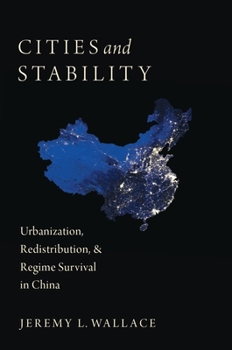
Cities and Stability: Urbanization, Redistribution, and Regime Survival in China
No Customer Reviews

China's management of urbanization is an under-appreciated factor in the regime's longevity. The Chinese Communist Party fears "Latin Americanization" -- the emergence of highly unequal megacities with their attendant slums and social unrest. Such cities threaten the survival of nondemocratic regimes. To combat the threat, many regimes, including China's, favor cities in policymaking. Cities and Stability shows this "urban bias" to be a Faustian Bargain: cities may be stabilized for a time, but the massive in-migration from the countryside that results can generate the conditions for political upheaval. Through its hukou system of internal migration restrictions, China has avoided this dilemma, simultaneously aiding urbanites and keeping farmers in the countryside. The system helped prevent social upheaval even during the Great Recession, when tens of millions of laid-off migrant workers dispersed from coastal cities. Jeremy Wallace's powerful account forces us to rethink the relationship between cities and political stability throughout the developing world.
Format:Paperback
Language:English
ISBN:0199378991
ISBN13:9780199378999
Release Date:July 2014
Publisher:Oxford University Press
Length:264 Pages
Weight:0.82 lbs.
Dimensions:0.7" x 6.3" x 9.5"
Customer Reviews
0 rating
Copyright © 2026 Thriftbooks.com
Terms of Use | Privacy Policy | Do Not Sell/Share My Personal Information | Cookie Notice | Cookie Preferences | Accessibility Statement
ThriftBooks ® and the ThriftBooks ® logo are registered trademarks of Thrift Books Global, LLC
ThriftBooks ® and the ThriftBooks ® logo are registered trademarks of Thrift Books Global, LLC
