


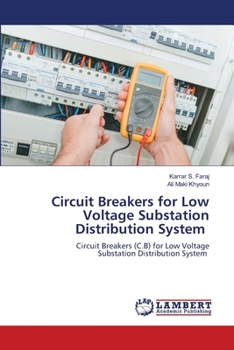
Circuit Breakers for Low Voltage Substation Distribution System
No Customer Reviews

The Circuit Breaker (C.B) is a device for disconnecting and connecting to the electrical circuit. Its location is between the electrical source and the loads fed from this source, and the mechanical parts move in it, either manually or electrically, to work in turn to separate the electrical current on the center of the loads, regardless of whether they are engines, or lighting circuits, or fed to electrical panels or control and control circuits. The C.B can be operated manually, electrically or automatically in different forms, methods and connections, and it may be equipped with protection elements for all electrical circuits. The occurrence of a short circuit, an error, an increase in the load or current, or in the event of a decrease or increase in voltage, other signals received from the different types of relays. Where we talked in the first chapter about an introduction to the low-voltage electrical C.B, which is the subject of research. The second chapter was about the types of breakers. The third chapter was about the design of a C.B. The fourth chapter was about the most prominent conclusions and developments regarding the electrical C.B.
Format:Paperback
Language:English
ISBN:6206142787
ISBN13:9786206142782
Release Date:March 2023
Publisher:LAP Lambert Academic Publishing
Length:52 Pages
Weight:0.20 lbs.
Dimensions:0.1" x 6.0" x 9.0"
Customer Reviews
0 rating
Copyright © 2025 Thriftbooks.com
Terms of Use | Privacy Policy | Do Not Sell/Share My Personal Information | Cookie Policy | Cookie Preferences | Accessibility Statement
ThriftBooks ® and the ThriftBooks ® logo are registered trademarks of Thrift Books Global, LLC
ThriftBooks ® and the ThriftBooks ® logo are registered trademarks of Thrift Books Global, LLC
