


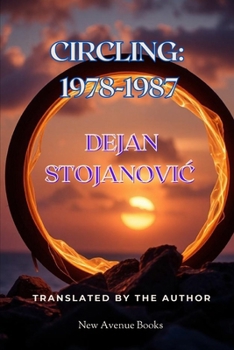
Circling: 1978-1987
No Customer Reviews

Select Format
Select Condition 
Book Overview
Circling is the book which I thoroughly enjoyed. Many fine little poems.
-Charles Simic In a colorful landscape of contemporary Serbian poetry, a careful reader can recognize that one of its branches, with a decidedly reflective experience of the poetic tradition and heritage, corresponds with a Serbian medieval age, opens up for its Byzantine chords, and, in the context of contemporary poetry, is closest to Modern Classicism. In the first wave of Serbian post-World War II poetry, this stream was at the very foundation of a revival, which is almost suppressed today. Today, amid almost complete saturation with ever-changing poetic trends, Serbian poetry is returning to its basics. This picture of a slow rebound, a long-awaited reorientation on the Serbian poetic scene, is already happening, by all accounts, and is sensed in the actual literary production. Reading the book Circling evokes associations with this wave, which is no longer underground but has transformed into a poetic phenomenon. Dejan Stojanovic is not influenced by any contemporary poetic school or fashionable poetic trend and is not trapped by some sensibility as a "follower." Stojanovic, as a reflective poet of mature thought and discourse, revives the atmosphere of ancient times even in the first layers of his poems. It is easy to notice what specifically marks Stojanovic in Serbian contemporary poetry: In weaving his poems and building his lines, a poet has returned to the ancient form of utterance, to the difficult and slow movement of the poetic matter, to the dignified and solemn tone, and that kind of wisdom which was nourished in ancient times. Far from experiments, challenges of hazards, and poetic adventures, Stojanovic's poems exude the dignity of ancient forms. Like painters' techniques, Stojanovic condenses his utterances into short, harmonious poems, most often colored with Mediterranean colors, surprisingly successfully. His poems, almost by rule, are condensed forms made of short utterances. In the book's second part, the poetic palette darkens with the introduction of fantastic and hallucinogenic elements, even apocalyptic tones. Nevertheless, the principle of condensation and consistency of form is never questioned. Apocalyptic scenes and images of evil are expressed in huge blocks that give the impression of the work of an architect or a sculptor. Such are the poems "Vision," The Chess Board," "Arrival of Darkness," and "River of Death," which all appear as compositions. There is a sense that Stojanovic wrote his poems alongside visual compositions; to that extent, the visual-imaginative effects are impressive. Specific, surprisingly original, outside the collectively nurtured sensibilities and fashionable trends, Stojanovic is an extraordinary example of creative individualism in a generation that nourished such individualism the least. For that reason, the book Circling is not only an extraordinary poetic achievement that strongly encourages the important branch of Serbian poetry but also an announcement of a moral and spiritual project. This project belongs to the tradition of Serbian poetry and thought in the best sense of the word.
-Alek Vukadinovic
Afterword, the first Serbian edition (1993) Dejan Stojanovic's poems are astute and spiritual tangents of a circle that comprises the phenomena hidden beyond the direct naming of the world and things in poetic transposition. In his poems, he seeks the boundaries between content and its metaphysical expression, between pure thought about the world and its essence. Passion and complete and easy-flowing devotion to poetry and to the power of words, poetically and semantically, above all, shape his original poetic output.
-Petar V. Arbutina
-Charles Simic In a colorful landscape of contemporary Serbian poetry, a careful reader can recognize that one of its branches, with a decidedly reflective experience of the poetic tradition and heritage, corresponds with a Serbian medieval age, opens up for its Byzantine chords, and, in the context of contemporary poetry, is closest to Modern Classicism. In the first wave of Serbian post-World War II poetry, this stream was at the very foundation of a revival, which is almost suppressed today. Today, amid almost complete saturation with ever-changing poetic trends, Serbian poetry is returning to its basics. This picture of a slow rebound, a long-awaited reorientation on the Serbian poetic scene, is already happening, by all accounts, and is sensed in the actual literary production. Reading the book Circling evokes associations with this wave, which is no longer underground but has transformed into a poetic phenomenon. Dejan Stojanovic is not influenced by any contemporary poetic school or fashionable poetic trend and is not trapped by some sensibility as a "follower." Stojanovic, as a reflective poet of mature thought and discourse, revives the atmosphere of ancient times even in the first layers of his poems. It is easy to notice what specifically marks Stojanovic in Serbian contemporary poetry: In weaving his poems and building his lines, a poet has returned to the ancient form of utterance, to the difficult and slow movement of the poetic matter, to the dignified and solemn tone, and that kind of wisdom which was nourished in ancient times. Far from experiments, challenges of hazards, and poetic adventures, Stojanovic's poems exude the dignity of ancient forms. Like painters' techniques, Stojanovic condenses his utterances into short, harmonious poems, most often colored with Mediterranean colors, surprisingly successfully. His poems, almost by rule, are condensed forms made of short utterances. In the book's second part, the poetic palette darkens with the introduction of fantastic and hallucinogenic elements, even apocalyptic tones. Nevertheless, the principle of condensation and consistency of form is never questioned. Apocalyptic scenes and images of evil are expressed in huge blocks that give the impression of the work of an architect or a sculptor. Such are the poems "Vision," The Chess Board," "Arrival of Darkness," and "River of Death," which all appear as compositions. There is a sense that Stojanovic wrote his poems alongside visual compositions; to that extent, the visual-imaginative effects are impressive. Specific, surprisingly original, outside the collectively nurtured sensibilities and fashionable trends, Stojanovic is an extraordinary example of creative individualism in a generation that nourished such individualism the least. For that reason, the book Circling is not only an extraordinary poetic achievement that strongly encourages the important branch of Serbian poetry but also an announcement of a moral and spiritual project. This project belongs to the tradition of Serbian poetry and thought in the best sense of the word.
-Alek Vukadinovic
Afterword, the first Serbian edition (1993) Dejan Stojanovic's poems are astute and spiritual tangents of a circle that comprises the phenomena hidden beyond the direct naming of the world and things in poetic transposition. In his poems, he seeks the boundaries between content and its metaphysical expression, between pure thought about the world and its essence. Passion and complete and easy-flowing devotion to poetry and to the power of words, poetically and semantically, above all, shape his original poetic output.
-Petar V. Arbutina
Format:Paperback
Language:English
ISBN:B0DP47MZL8
ISBN13:9798991946681
Release Date:November 2024
Publisher:New Avenue Books
Length:86 Pages
Weight:0.30 lbs.
Dimensions:0.2" x 6.0" x 9.0"
Related Subjects
PoetryCustomer Reviews
0 rating
Copyright © 2026 Thriftbooks.com Terms of Use
| Privacy Policy | Do Not
Sell/Share My Personal Information | Cookie Policy | Cookie Preferences | Accessibility Statement
ThriftBooks® and the ThriftBooks® logo are registered trademarks of Thrift Books Global, LLC
ThriftBooks® and the ThriftBooks® logo are registered trademarks of Thrift Books Global, LLC
