


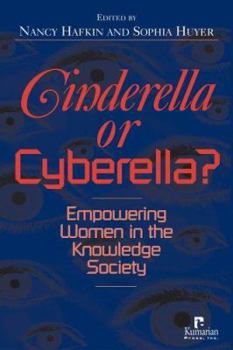
Cinderella or Cyberella?: Empowering Women in the Knowledge Society

Select Format
Select Condition 
Book Overview
Cinderella or Cyberella: what is the future for women in the knowledge society? Cyberella is fluent in the uses of technology, comfortable using and designing computer technology, and working in... This description may be from another edition of this product.
Format:Paperback
Language:English
ISBN:1565492196
ISBN13:9781565492196
Release Date:July 2006
Publisher:Kumarian Press, Inc.
Length:288 Pages
Weight:0.78 lbs.
Dimensions:9.0" x 0.5" x 6.0"
Customer Reviews
2 ratings
Obstacles and opportunities for women
Published by Thriftbooks.com User , 18 years ago
What role can information and communication technologies (ICT) play in women's aspirations? How can ICT advance their hopes for economic and social development and equal opportunity in societies in developing countries? Nancy Hafkin and Sophia Huyer, both well known as authorities in this field, bring together eight experts from a wide range of backgrounds, to explore these questions and related issues in this very readable and highly informative compilation. ICTs here incorporate not only computer and internet technology but also cell phones and community radio, the latter two being of particular importance in less industrialized countries. In the first substantive article Huyer places gender equality and women's empowerment in the "knowledge society" in a wider human development context. She provides an excellent brief historical overview of the gender-and-development debate and definitions of key concepts and perspectives. As well, she summarizes the specific donor viewpoints on women empowerment in the context of poverty reduction, as most recently expressed in the Millennium Development Goals. She launches the ensuing discussions in the other articles with the essential question: can ICTs contribute to women's empowerment? The short answer being "yes", Huyer identifies a number of successful examples in the area of economic, socio-cultural, psychological empowerment. Education, legal access and political participation are obvious additional areas where ICTs can have an enabling and/or supporting role to play. The author then touches on some of the limitations and barriers. For example, relevant investigations have shown that ICTs are not gender neutral, that teaching tools privilege boys over girls; even software developments do not usually take account of programs and applications that would be of interest and/or benefit to women. Societal barriers and perceptions add to disadvantaging women from accessing and using the technology options. Huyer argues for appropriate and relevant content, in particular with focus on women in developing countries and in rural areas. Here access to appropriate technology can mean the difference between life and death. For example, vital health information can be communicated through local radio; up-to-date information on weather patterns and crop planting advice can ensure that families grow the right foodstuffs successfully. Training women in the use of ICTs opens up new areas for employment and economic development. The range of applications is endless and there is no shortage of ideas and initiatives among women and local communities. Nancy Hafkin's article provides detailed sex-differentiated statistical data reinforcing some, but also challenging other, preconceived ideas of women's use of ICTs. Particularly striking is her summary of the findings that the level of access to and use of ICTs by women is not dependent on the level of ICT penetration in a given society as a whole. Increasing
Gender Update
Published by Thriftbooks.com User , 19 years ago
It is a very useful book, as a reference, for beginners or for experts, because it presents a small review of women's issues to date and presents a challenge to the upcoming years, in the context of information and communications technologies. Useful for students and professionals, feminists or not...
Copyright © 2026 Thriftbooks.com
Terms of Use | Privacy Policy | Do Not Sell/Share My Personal Information | Cookie Policy | Cookie Preferences | Accessibility Statement
ThriftBooks ® and the ThriftBooks ® logo are registered trademarks of Thrift Books Global, LLC
ThriftBooks ® and the ThriftBooks ® logo are registered trademarks of Thrift Books Global, LLC
