


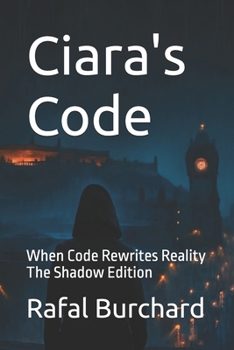
Ciara's Code: When Code Rewrites Reality - The Shadow Edition
No Customer Reviews

The story you are about to read does not begin with a bang. It starts with a whisper disguised as code, a quiet reshuffling of the rules that hold the world together. It is a tale about power-the kind that doesn't need missiles or parliaments to change history-wielded by those who can persuade reality to listen. At its centre is Ciara MacLeod: a reluctant architect of a technology that turns information into instruction for matter, a discovery born in isolation and meant, naively, to heal. Around her, a cast of familiar forces-presidents and premiers, billionaires with appetites, agencies with acronyms-do what they have always done: circle the new fire, then argue over who owns it.
Edinburgh is the stage, not by coincidence but by design. Beneath its old stones and civility, the city conceals rooms within rooms, where scholars have long argued with the universe and sometimes prevailed. In these vaults and halls, a modern alchemy unfolds: global infrastructure is rewired in minutes; markets become fair; traffic moves with intelligence; satellites age backwards; hospitals see what was always there, just out of view. A demonstration, not a threat-until someone decides to make it both. This is a thriller about the physics of control and the ethics of invention. It asks what happens when the operating system of reality becomes editable and the patch notes are public. It is also a very human story: a woman choosing to stand before the world and say, plainly, 'This can save us, ' and in the same breath, 'If we're careless, this will end us.' She is hunted for that honesty-by states seeking leverage, by corporations seeking ownership, and by those who would burn down the house to prove they could.
The narrative moves fast because history will. It moves through situation rooms and secret labs, hotel suites with castle views and corridors under ancient streets. The humour is dark because the stakes demand it; sometimes, the only way to look at the abyss is with a raised eyebrow. The science is audacious but purposeful: here, quantum vocabulary is less ornament than engine, never a spell to wave away logic but a language to make the impossible precise. If this book has a thesis, it is this: every breakthrough is a mirror. It shows us what we can do, and then it shows us who we are. The code at the heart of this story is not a villain or a saviour; it is an amplifier. In the hands of the fearful, it makes better cages. In the hands of the greedy, it makes sharper knives. In the hands of the brave-of the careful, the collaborative-it hints at a civilisation that might yet outgrow its habit of confusing strength with dominance.
You will meet people who want to save the world and people who wish to own it. Often, they are the same people before breakfast. You will see institutions reaching for the only tools they understand, and you will watch those tools fail. You will watch a young woman suture her wound and then go back to rewriting the future because there isn't time to do one after the other. This is not a story about the end of the world. It is a story about the end of one version-and the negotiation that follows. If we are lucky, we negotiate with imagination instead of fear. If we are wise, we remember that technology is only ever as moral as the agreements we build around it.
The old world ends, someone declares. Perhaps. But endings, like beginnings, are choices. This novel is about making them under pressure, with enemies at the door and history on hold. If it entertains you, good. Suppose it unnerves you, better. If it leaves you wondering what you would do with the power to change the rules-and whether you would trust anyone else to do it at all-then it has done its job.
Welcome to the negotiation.
Edinburgh is the stage, not by coincidence but by design. Beneath its old stones and civility, the city conceals rooms within rooms, where scholars have long argued with the universe and sometimes prevailed. In these vaults and halls, a modern alchemy unfolds: global infrastructure is rewired in minutes; markets become fair; traffic moves with intelligence; satellites age backwards; hospitals see what was always there, just out of view. A demonstration, not a threat-until someone decides to make it both. This is a thriller about the physics of control and the ethics of invention. It asks what happens when the operating system of reality becomes editable and the patch notes are public. It is also a very human story: a woman choosing to stand before the world and say, plainly, 'This can save us, ' and in the same breath, 'If we're careless, this will end us.' She is hunted for that honesty-by states seeking leverage, by corporations seeking ownership, and by those who would burn down the house to prove they could.
The narrative moves fast because history will. It moves through situation rooms and secret labs, hotel suites with castle views and corridors under ancient streets. The humour is dark because the stakes demand it; sometimes, the only way to look at the abyss is with a raised eyebrow. The science is audacious but purposeful: here, quantum vocabulary is less ornament than engine, never a spell to wave away logic but a language to make the impossible precise. If this book has a thesis, it is this: every breakthrough is a mirror. It shows us what we can do, and then it shows us who we are. The code at the heart of this story is not a villain or a saviour; it is an amplifier. In the hands of the fearful, it makes better cages. In the hands of the greedy, it makes sharper knives. In the hands of the brave-of the careful, the collaborative-it hints at a civilisation that might yet outgrow its habit of confusing strength with dominance.
You will meet people who want to save the world and people who wish to own it. Often, they are the same people before breakfast. You will see institutions reaching for the only tools they understand, and you will watch those tools fail. You will watch a young woman suture her wound and then go back to rewriting the future because there isn't time to do one after the other. This is not a story about the end of the world. It is a story about the end of one version-and the negotiation that follows. If we are lucky, we negotiate with imagination instead of fear. If we are wise, we remember that technology is only ever as moral as the agreements we build around it.
The old world ends, someone declares. Perhaps. But endings, like beginnings, are choices. This novel is about making them under pressure, with enemies at the door and history on hold. If it entertains you, good. Suppose it unnerves you, better. If it leaves you wondering what you would do with the power to change the rules-and whether you would trust anyone else to do it at all-then it has done its job.
Welcome to the negotiation.
Format:Paperback
Language:English
ISBN:B0FMK3BH7K
ISBN13:9798298150477
Release Date:August 2025
Publisher:Independently Published
Length:296 Pages
Weight:0.88 lbs.
Dimensions:0.6" x 6.0" x 9.0"
Customer Reviews
0 rating
Copyright © 2025 Thriftbooks.com
Terms of Use | Privacy Policy | Do Not Sell/Share My Personal Information | Cookie Policy | Cookie Preferences | Accessibility Statement
ThriftBooks ® and the ThriftBooks ® logo are registered trademarks of Thrift Books Global, LLC
ThriftBooks ® and the ThriftBooks ® logo are registered trademarks of Thrift Books Global, LLC
