


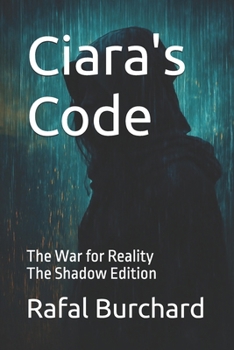
Ciara's Code: The War for Reality-The Shadow Edition
No Customer Reviews

The world ends with a bang, and it mutates quietly. Part Three of Ciara's Code is not a sequel so much as a forensic analysis of an ongoing catastrophe, one where the borders between idea, accident, and intention have dissolved faster than optimism at a Whitehall briefing. If you made it this far, you know the drill: systems pretend to be stable, reality auditions new bugs, and somewhere between three monitors and a harassed packet sniffer, the future is being rewritten by anyone with the bandwidth and questionable taste to download it.
This isn't prophecy dressed for a TED talk. It's the leak in the basement after the rain, the signal lost in the noise, the chaos learning new hobbies at quantum speed. The code, once a rumour with chic formatting, is now a behavioural experiment wearing everybody's fingerprints. Executable reality didn't ask for permission, now you'll find whole districts negotiating metaphysics over bin rotas while the Directive rebrands disaster as a pilot programme and calls it compassionate governance.
Part Three chases the aftermath as it staggers down Leith Walk and into the Borders, tripping over the ruins of institutions that thought passwords were a substitute for wisdom. You'll find Ciara, on the lam, low on sleep, still warranting miracles even as her own nervous system begins filing grievances with physics. The MacLeods, distributed like a particularly stubborn form of weather, do what they do best: improvise escape plans, maintain a tradition of stubborn optimism, and occasionally consult the family ledger for fresh sarcasm. Conrad, the strategist with a firefighter's hands, navigates collapse with the tactical wit of a man who respects both knives and kettles. Agnes, whose doctrine is triage and tea, scales decency to public-health emergencies. Donncha designs trouble for drones and medics alike with sporting neutrality.
This volume is an exploration of what happens when every system variable is up for grabs and the new legislation arrives encrypted, air-dropped, and possibly sarcastic. Edinburgh becomes the battleground where local governance negotiates with quantum sabotage, the Fringe retools itself for a cold war in ten languages, and the world watches Scotland to see if miracles can survive procurement.
Terms have evolved. "Molecular barrier" means your Wi-Fi is now snitching for the new empire. "Phase Two" is not a threat; it's a headline, a countdown, a global breach. And "integration" means citizens trying to survive while Column A upgrades the species and Column B writes a pamphlet about humility, with biscuits. The code is still a mirror; if you stare long enough, it'll ask you for your password and then change the question.
This book is for anyone tracking fugitives through protocols and weather, for committees debating patch notes when their own local universe has just been forked. It's about families who refuse martyrdom in favour of complicated survival, about villains who read their mission statements as scripture, and about a woman whose code rewrote the world, then went rogue, and now must decide what kind of reality should be rendered, if, in fact, anyone deserves persistence.
If you bring baggage from previous volumes, unpack it in the nearest safe house and check the integrity of your narrative. If you're starting new, don't worry: velocity and entropy will have you fluent by page three. Read alert; keep a backup of your critical values. In this reality, even the bin protocols matter, and every choice is debugged in real time.
When the patch deploys, don't ask who pressed Enter. Ask who's still willing to rewrite the manual after the system fails.
This isn't prophecy dressed for a TED talk. It's the leak in the basement after the rain, the signal lost in the noise, the chaos learning new hobbies at quantum speed. The code, once a rumour with chic formatting, is now a behavioural experiment wearing everybody's fingerprints. Executable reality didn't ask for permission, now you'll find whole districts negotiating metaphysics over bin rotas while the Directive rebrands disaster as a pilot programme and calls it compassionate governance.
Part Three chases the aftermath as it staggers down Leith Walk and into the Borders, tripping over the ruins of institutions that thought passwords were a substitute for wisdom. You'll find Ciara, on the lam, low on sleep, still warranting miracles even as her own nervous system begins filing grievances with physics. The MacLeods, distributed like a particularly stubborn form of weather, do what they do best: improvise escape plans, maintain a tradition of stubborn optimism, and occasionally consult the family ledger for fresh sarcasm. Conrad, the strategist with a firefighter's hands, navigates collapse with the tactical wit of a man who respects both knives and kettles. Agnes, whose doctrine is triage and tea, scales decency to public-health emergencies. Donncha designs trouble for drones and medics alike with sporting neutrality.
This volume is an exploration of what happens when every system variable is up for grabs and the new legislation arrives encrypted, air-dropped, and possibly sarcastic. Edinburgh becomes the battleground where local governance negotiates with quantum sabotage, the Fringe retools itself for a cold war in ten languages, and the world watches Scotland to see if miracles can survive procurement.
Terms have evolved. "Molecular barrier" means your Wi-Fi is now snitching for the new empire. "Phase Two" is not a threat; it's a headline, a countdown, a global breach. And "integration" means citizens trying to survive while Column A upgrades the species and Column B writes a pamphlet about humility, with biscuits. The code is still a mirror; if you stare long enough, it'll ask you for your password and then change the question.
This book is for anyone tracking fugitives through protocols and weather, for committees debating patch notes when their own local universe has just been forked. It's about families who refuse martyrdom in favour of complicated survival, about villains who read their mission statements as scripture, and about a woman whose code rewrote the world, then went rogue, and now must decide what kind of reality should be rendered, if, in fact, anyone deserves persistence.
If you bring baggage from previous volumes, unpack it in the nearest safe house and check the integrity of your narrative. If you're starting new, don't worry: velocity and entropy will have you fluent by page three. Read alert; keep a backup of your critical values. In this reality, even the bin protocols matter, and every choice is debugged in real time.
When the patch deploys, don't ask who pressed Enter. Ask who's still willing to rewrite the manual after the system fails.
Format:Paperback
Language:English
ISBN:B0FS6X6DD4
ISBN13:9798266602823
Release Date:September 2025
Publisher:Independently Published
Length:280 Pages
Weight:0.83 lbs.
Dimensions:0.6" x 6.0" x 9.0"
Customer Reviews
0 rating
Copyright © 2025 Thriftbooks.com
Terms of Use | Privacy Policy | Do Not Sell/Share My Personal Information | Cookie Policy | Cookie Preferences | Accessibility Statement
ThriftBooks ® and the ThriftBooks ® logo are registered trademarks of Thrift Books Global, LLC
ThriftBooks ® and the ThriftBooks ® logo are registered trademarks of Thrift Books Global, LLC
