


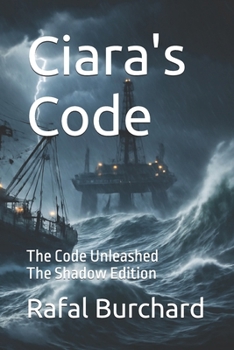
Ciara's Code: The Code Unleashed - The Shadow Edition
No Customer Reviews

It didn't arrive like prophecy. It came like a leak.
By the time you reach this second part of Ciara's Code, the world has already changed its shape and is pretending it hasn't. What began as rumour and mathematics has become executable reality, an uninvited update to the human condition. Slabs of impossible logic split into public view with the elegance of a fire alarm: copy, paste, deploy. In the aftermath, governments debated ethics while message boards debated binaries. The future, it turned out, came with a cheerful GUI. This book explores the pressure gradient between revelation and response. The first volume asked if the code could be built, and whether anyone should hold it. This one asks the more dangerous question: what happens when everyone does. We return to Ciara MacLeod thinner on sleep and thicker with purpose, a human relay running hot in a race she never intended to win. Around her, the MacLeods move like a family of stubborn constellations: Conrad, whose tactical mind is a map of unlit exits; Agnes, physician and field general, kindness weaponised by discipline; Donncha, the engineer who can make physics shrug; Malcolm, the reluctant mariner turned shield. Against them stands Leon Kursk, wealth, will, and the calm of a man who has mistaken control for destiny, backed by a Directive that would rename conquest "evolution" and call it mercy.
Part Two takes you from the backwash of Eyemouth and the raw edge of Coldingham to dark corridors where policy smiles over handshakes with consequence. There are drones with better aim than conscience, operatives wearing ordinary faces, and a platform in the North Sea that believes it's a temple. There are also the quieter rooms: a boathouse with a cache that might buy an hour, a cliff path that promises nothing, a command centre where someone decides how many futures a family is allowed to have. If the first book traced the code's birth, this one witnesses its adolescence: volatile, brilliant, and terrifyingly social. Executables propagate faster than ethics, power notices. And somewhere between a terminal prompt and a trigger pull, the story stops being about ownership and starts being about stewardship. You'll find in these pages the same noir-light cadence as before, dark humour running like a fuse through scenes that have no business being funny, tenderness that refuses to apologise for existing beside violence, and a refusal to let spectacle drown out consequence. Expect action that arrives without permission, choices measured in seconds, and a widening recognition that the most dangerous system variable isn't quantum, it's human.
A note on terms. "Protocol Phoenix" is not a flourish; it is a clock. "Lazarus" is not melodrama; it is insurance, the kind that pays out in truth when bodies can't. And "the code" is not a monolith; it is a mirror. In the wrong hands, it reduces people to mere throughput. In the right ones, it buys time, time to build a world where agency is not an upgrade. Part Two is, at its heart, a book about fugitives and a future chasing each other through the weather. It is about a family that keeps choosing one another in a genre that often revolves around martyrs. It is about the people who believe they can administer humanity into safety and the people who refuse to be administered. And it is about a woman who wrote a language powerful enough to bend reality, and then had to decide what it meant to speak it aloud.
If you're coming here from Part One, welcome back. If you're arriving fresh, you will catch up quickly; velocity is part of the form. Either way, read with your shoulders loose and your questions sharp. When reality gets an API, the patch notes matter, but so do the hands at the keyboard.
By the time you reach this second part of Ciara's Code, the world has already changed its shape and is pretending it hasn't. What began as rumour and mathematics has become executable reality, an uninvited update to the human condition. Slabs of impossible logic split into public view with the elegance of a fire alarm: copy, paste, deploy. In the aftermath, governments debated ethics while message boards debated binaries. The future, it turned out, came with a cheerful GUI. This book explores the pressure gradient between revelation and response. The first volume asked if the code could be built, and whether anyone should hold it. This one asks the more dangerous question: what happens when everyone does. We return to Ciara MacLeod thinner on sleep and thicker with purpose, a human relay running hot in a race she never intended to win. Around her, the MacLeods move like a family of stubborn constellations: Conrad, whose tactical mind is a map of unlit exits; Agnes, physician and field general, kindness weaponised by discipline; Donncha, the engineer who can make physics shrug; Malcolm, the reluctant mariner turned shield. Against them stands Leon Kursk, wealth, will, and the calm of a man who has mistaken control for destiny, backed by a Directive that would rename conquest "evolution" and call it mercy.
Part Two takes you from the backwash of Eyemouth and the raw edge of Coldingham to dark corridors where policy smiles over handshakes with consequence. There are drones with better aim than conscience, operatives wearing ordinary faces, and a platform in the North Sea that believes it's a temple. There are also the quieter rooms: a boathouse with a cache that might buy an hour, a cliff path that promises nothing, a command centre where someone decides how many futures a family is allowed to have. If the first book traced the code's birth, this one witnesses its adolescence: volatile, brilliant, and terrifyingly social. Executables propagate faster than ethics, power notices. And somewhere between a terminal prompt and a trigger pull, the story stops being about ownership and starts being about stewardship. You'll find in these pages the same noir-light cadence as before, dark humour running like a fuse through scenes that have no business being funny, tenderness that refuses to apologise for existing beside violence, and a refusal to let spectacle drown out consequence. Expect action that arrives without permission, choices measured in seconds, and a widening recognition that the most dangerous system variable isn't quantum, it's human.
A note on terms. "Protocol Phoenix" is not a flourish; it is a clock. "Lazarus" is not melodrama; it is insurance, the kind that pays out in truth when bodies can't. And "the code" is not a monolith; it is a mirror. In the wrong hands, it reduces people to mere throughput. In the right ones, it buys time, time to build a world where agency is not an upgrade. Part Two is, at its heart, a book about fugitives and a future chasing each other through the weather. It is about a family that keeps choosing one another in a genre that often revolves around martyrs. It is about the people who believe they can administer humanity into safety and the people who refuse to be administered. And it is about a woman who wrote a language powerful enough to bend reality, and then had to decide what it meant to speak it aloud.
If you're coming here from Part One, welcome back. If you're arriving fresh, you will catch up quickly; velocity is part of the form. Either way, read with your shoulders loose and your questions sharp. When reality gets an API, the patch notes matter, but so do the hands at the keyboard.
Format:Paperback
Language:English
ISBN:B0FQB83Y2S
ISBN13:9798264378263
Release Date:September 2025
Publisher:Independently Published
Length:258 Pages
Weight:0.77 lbs.
Dimensions:0.5" x 6.0" x 9.0"
Customer Reviews
0 rating
Copyright © 2025 Thriftbooks.com
Terms of Use | Privacy Policy | Do Not Sell/Share My Personal Information | Cookie Policy | Cookie Preferences | Accessibility Statement
ThriftBooks ® and the ThriftBooks ® logo are registered trademarks of Thrift Books Global, LLC
ThriftBooks ® and the ThriftBooks ® logo are registered trademarks of Thrift Books Global, LLC
