


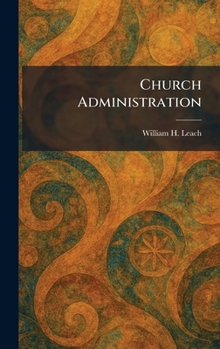
Church Administration

"Church Administration" is a comprehensive and practical guide dedicated to the organizational and management challenges faced by religious institutions. Written by William H. Leach, this work reflects the early twentieth-century movement toward professionalizing church operations and applying systematic methods to the life of the congregation.
The text delves into a wide array of essential topics, including financial management, the oversight of church committees, and the effective coordination of community outreach programs. Leach provides detailed strategies for record-keeping, building maintenance, and the integration of educational initiatives within the parish. By focusing on the administrative duties of the pastor and lay leaders, the book illustrates how structured planning can enhance the spiritual mission of the church.
This work serves as an important historical document for those interested in the evolution of pastoral leadership and the structural development of American Protestantism. It offers a unique window into a time when efficiency and organization became central to maintaining a vibrant and sustainable religious community. "Church Administration" remains a valuable resource for understanding the foundational principles of ministry management and the enduring complexities of ecclesiastical governance.
This work has been selected by scholars as being culturally important, and is part of the knowledge base of civilization as we know it. This work was reproduced from the original artifact, and remains as true to the original work as possible. Therefore, you may see the original copyright references, library stamps (as most of these works have been housed in our most important libraries around the world), and other notations in the work.
This work is in the public domain in the United States of America, and possibly other nations. Within the United States, you may freely copy and distribute this work, as no entity (individual or corporate) has a copyright on the body of the work.
As a reproduction of a historical artifact, this work may contain missing or blurred pages, poor pictures, errant marks, etc. Scholars believe, and we concur, that this work is important enough to be preserved, reproduced, and made generally available to the public. We appreciate your support of the preservation process, and thank you for being an important part of keeping this knowledge alive and relevant.
Customer Reviews
ThriftBooks ® and the ThriftBooks ® logo are registered trademarks of Thrift Books Global, LLC
