


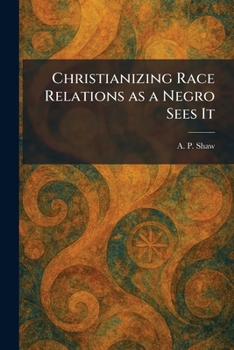
Christianizing Race Relations as a Negro Sees It

"Christianizing Race Relations as a Negro Sees It" is a compelling call to action that explores the moral and spiritual dimensions of racial inequality in the United States. Written from the perspective of an African American religious leader during the early 20th century, this work examines the profound gap between Christian doctrine and the systemic injustices faced by Black Americans. Alexander Preston Shaw provides a thoughtful critique of contemporary social structures, arguing that true Christianity requires the dismantling of racial prejudice and the establishment of genuine social justice.
Through a lens of faith and social ethics, the book addresses the urgent need for a transformative approach to human relations. Shaw highlights the shared humanity of all people and challenges religious institutions to lead the way in fostering equality and reconciliation. This significant historical text remains a powerful testament to the long-standing dialogue between religion and the pursuit of civil rights, offering valuable insights into the African American intellectual tradition and the application of Christian principles to social reform.
This work has been selected by scholars as being culturally important, and is part of the knowledge base of civilization as we know it. This work was reproduced from the original artifact, and remains as true to the original work as possible. Therefore, you may see the original copyright references, library stamps (as most of these works have been housed in our most important libraries around the world), and other notations in the work.
This work is in the public domain in the United States of America, and possibly other nations. Within the United States, you may freely copy and distribute this work, as no entity (individual or corporate) has a copyright on the body of the work.
As a reproduction of a historical artifact, this work may contain missing or blurred pages, poor pictures, errant marks, etc. Scholars believe, and we concur, that this work is important enough to be preserved, reproduced, and made generally available to the public. We appreciate your support of the preservation process, and thank you for being an important part of keeping this knowledge alive and relevant.
Customer Reviews
ThriftBooks ® and the ThriftBooks ® logo are registered trademarks of Thrift Books Global, LLC
