


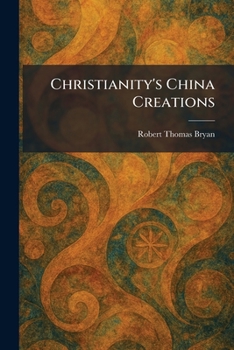
Christianity's China Creations

"Christianity's China Creations" provides a compelling and historical exploration of the impact of Christian missions in China during a period of significant social and political transition. Written by Robert Thomas Bryan, a long-serving missionary, the work details the various institutions and cultural shifts catalyzed by missionary activity in the early 20th century. From the establishment of educational facilities and medical centers to the growth of localized congregations, the text examines how Western religious thought intersected with traditional Chinese values.
The narrative offers a detailed look at the practical and spiritual challenges faced by those seeking to plant the seeds of faith in the Far East. It serves as both a chronicle of institutional development and a reflection on the broader sociological effects of the Christian movement within the country. This work is an essential resource for students of religious history, Asian studies, and those interested in the complex history of cross-cultural exchange. Through its focus on the "creations" born of these efforts, "Christianity's China Creations" captures a unique moment in the history of global Christianity and its enduring legacy in the East.
This work has been selected by scholars as being culturally important, and is part of the knowledge base of civilization as we know it. This work was reproduced from the original artifact, and remains as true to the original work as possible. Therefore, you may see the original copyright references, library stamps (as most of these works have been housed in our most important libraries around the world), and other notations in the work.
This work is in the public domain in the United States of America, and possibly other nations. Within the United States, you may freely copy and distribute this work, as no entity (individual or corporate) has a copyright on the body of the work.
As a reproduction of a historical artifact, this work may contain missing or blurred pages, poor pictures, errant marks, etc. Scholars believe, and we concur, that this work is important enough to be preserved, reproduced, and made generally available to the public. We appreciate your support of the preservation process, and thank you for being an important part of keeping this knowledge alive and relevant.
Customer Reviews
ThriftBooks ® and the ThriftBooks ® logo are registered trademarks of Thrift Books Global, LLC
