


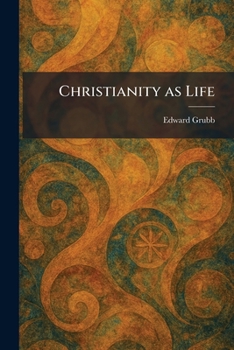
Christianity as Life

Select Format
Select Condition 
Book Overview
"Christianity as Life" explores the essence of the Christian faith as an active, lived experience rather than a collection of rigid dogmas or abstract doctrines. Written by the influential Quaker thinker Edward Grubb, this work delves into the intersection of spiritual belief and daily conduct, emphasizing the transformative power of the inward light. Grubb argues that true Christianity is found in the vitality of the spirit and the ethical application of Christ's teachings to the challenges of modern existence.
The text reflects a deep commitment to the Quaker values of simplicity, integrity, and social responsibility, offering readers a contemplative yet practical guide to spiritual growth. Through a series of thoughtful reflections, the author examines the nature of faith, the importance of community, and the ongoing search for truth in a changing world. This volume remains a significant contribution to early 20th-century religious thought, appealing to those interested in the Quaker tradition, Christian ethics, and the pursuit of a meaningful spiritual life.
This work has been selected by scholars as being culturally important, and is part of the knowledge base of civilization as we know it. This work was reproduced from the original artifact, and remains as true to the original work as possible. Therefore, you may see the original copyright references, library stamps (as most of these works have been housed in our most important libraries around the world), and other notations in the work.
This work is in the public domain in the United States of America, and possibly other nations. Within the United States, you may freely copy and distribute this work, as no entity (individual or corporate) has a copyright on the body of the work.
As a reproduction of a historical artifact, this work may contain missing or blurred pages, poor pictures, errant marks, etc. Scholars believe, and we concur, that this work is important enough to be preserved, reproduced, and made generally available to the public. We appreciate your support of the preservation process, and thank you for being an important part of keeping this knowledge alive and relevant.
Customer Reviews
ThriftBooks ® and the ThriftBooks ® logo are registered trademarks of Thrift Books Global, LLC
