
Skip to content
Scan a barcode
Scan
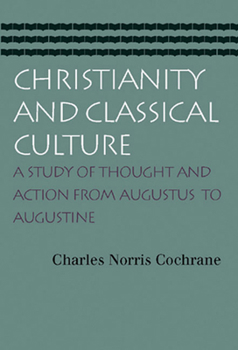
Paperback Christianity and Classical Culture: A Study of Thought and Action from Augustus to Augustine Book

ISBN: 0865974136

ISBN13: 9780865974135

Christianity and Classical Culture: A Study of Thought and Action from Augustus to Augustine

Select Format

Select Condition ThriftBooks Help Icon

Recommended

Format: Paperback

Condition: Good

$11.39
Save $0.61!
List Price $12.00
Almost Gone, Only 2 Left!
Save to List

Book Overview

Christianity and Classical Culture is considered one of the great works of scholarship published in the last century. The theme of Christianity and Classical Culture is the fundamental change in thought and action that occurred from the reign of Augustus to the time of Augustine. The classical world sought to practice politics and understand the world in purely rational terms, but the difficulties of this program were already evident as Christianity began developing a completely new understanding of the human world. It is from this revolution in ideas that our modern world was forged.

W. H. Auden wrote of an earlier edition in The New Republic: "Since the appearance of the first edition in 1940, I have read this book many times, and my conviction of its importance to the understanding not only of the epoch with which it is concerned, but also of our own, has increased with each rereading."

Charles Norris Cochrane (1889-1945) was educated at the University of Toronto and Oxford (Corpus Christi College) and taught at the University of Toronto.

Customer Reviews

5 ratings

Christianity and Classical Culture

One of C.S. Lewis's maxims I agree with (but too often fail to heed) is this: for every just-published book you read be sure and read at least two old books, classics which have stood steady amidst the winds of change. I've recently feasted on some durable classics which truly deserve their acclaim. To understand Christianity, we need to know ancient history as well as biblical texts, to appreciate foundational thinkers as well as more recent interpreters. Charles Norris Cochrane's Christianity and Classical Culture: A Study of Thought and Action from Augustus to Augustine (New York: Oxford University Press, 1957, 1st pub. 1940) provides a classic text which I first read years ago and recently re-read to my profit. In Part I, "Reconstruction," Cochrane describes the development of the Roman Empire, replacing the Roman Republic, the fulfillment of Augustus' designs. Impressive on many counts (e.g. establishing a judicial system based upon the natural law), Rome's world conquest simultaneously imposed "a virtual servitude for all but the few in whose hands lay the means of exploitation, the control of economic and political power" (p. 18). Along with its political structures, one learns, under Cochrane's tutelage, to appreciate the intellectual struggles between the philosophical advocates of materialism and idealism, neither of which fully satisfied the soul of antiquity, opening doors of opportunity for the message of the Early Church. In some significant ways--for the ultimate failure of Rome, as Tacitus and others argued, was due to spiritual bankruptcy--the Church gradually replaced the Empire as the only cohesive, preeminent social institution bequeathed by antiquity to the Medieval Era. The empire collapsed amidst a litany of liabilities: increasingly oppressive taxation which drove the rich to flight and the common folks to despair; the bankruptcy of municipalities as well as individuals; the professionalization and accompanying decay of the military; increasing crime and violence. (Though I routinely warn students not to simplistically equate "symptoms" of decay in ancient Rome with trends in today's society, it was frankly difficult, while reading Cochrane, to refrain from drawing uncomfortably close parallels myself!) In Part II, "Renovation," we explore the "new republic" which Constantine established. "The year 313 [when Constantine issued the 'Edict of Milan' and granted religious toleration to Christians] has rightly been taken to mark a turning-point in European history" (p. 177). Fifty years after Constantine's edict of toleration, another emperor, Theodosius, imposed Christianity as the "official" religion of the empire, and what we label "Western Christian Culture" gained political power and prominence. Concerning Constantine, Cochrane neither celebrates nor denigrates his efforts. In a rather fair appraisal, he presents the emperor's work as a blend of sincere religious conviction and shrew polit

A real classic

This work has long been known to scholars in the field and is one of the best interpretive works on the relationship between classical culture and Christianity. If many of the judgments may seem a little assured to a new reader, (the first edition came out in 1940) Cochrane handles the extremely complex material with poise and skill, and the work is extremely well-written. For a more recent take on this subject see Jaroslav Pelikan, Christianity and classical culture: the metamorphosis of natural theology in the Christian encounter with Hellenism. (New Haven: Yale University Press, 1993).

Cult of State and Cult of Christ become One

If you want to know how, and why, romanitas became christianitas, this is the book for you. But make no mistake, this isn't any gloss of the process, this is an in-depth as a how-to discussion of surgery.I've been through this book twice, and I'm always amazed by Cochrane's ability. It helps me (always) to have a primer on Roman history out as I go through it - to check on some of his references and "name-dropping." A Latin dictionary doesn't hurt, either (my Latin's a little rusty since college).If you want an extensive examination of the christianization of the Roman empire, get this book!

A pillar of philosophical, religious, and cultural analysis

Originally published in 1940, Christianity And Classical Culture: A Study Of Thought And Action From Augustus To Augustine by Charles Norris Chochrane (1889-1945) is a thoughtful, insightful, informative examination of the contrast and sometimes clash between the classical era's culture and struggle to understand the world in purely rational terms, and the completely new understanding of the world developed and spread by Christianity. From divisions of church and state; to the impact that Constantine and the spread of Christianity had; to a technical dissection of propositions concerning sometimes starkly different worldviews, Christianity and Classic Culture has survived the test of time to remain a pillar of philosophical, religious, and cultural analysis.

The Fall of Rome and the Rise of Christendom

This is a comprehensive narrative of the decline of the classical pagan world and the rise of the Christian middle ages. It is aptly subtitled, "A Study of Thought and Action from Augustus to Augustine," for those two men stand out as the bookends of the transition. The story begins with Eternal Rome at the end of the Republic, and generally with the claims of pagan Rome to finality and mastery -- perfected science in the classical sense -- over the political order of the world. It ends with the destruction of the Empire and the seminal thinker of the next thousand years, Aurelius Augustine. On the way, Cochrane weaves together military history, theology, poetry, philosophy, law and politics in a prose that is certainly not to be confused with Gibbon, but is nonetheless quite readable. Cochrane's avowed mission is to let the classical authors, pagan and Christian alike, speak for themselves and for their positions, and this he does with remarkable fairness. A principal question of the book is, who won the war of philosophers and theologians? Did Athens conquer Jerusalem, imposing classical pagan or Platonic ideas on a Christianity now lost, or did Jerusalem conquer Athens, replacing the classical ways of thought in a radical way? The answer, as one might expect, is complicated, but intelligible. The book is 500 pages long, but will repay multiple readings.
Copyright © 2026 Thriftbooks.com Terms of Use | Privacy Policy | Do Not Sell/Share My Personal Information | Cookie Policy | Cookie Preferences | Accessibility Statement
ThriftBooks® and the ThriftBooks® logo are registered trademarks of Thrift Books Global, LLC

GoDaddy Verified and Secured