


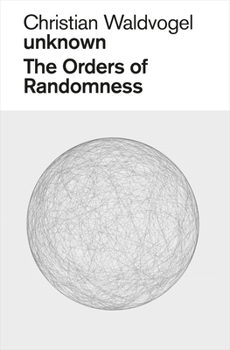
Christian Waldvogel. Unknown: The Orders of Randomness
No Customer Reviews

Christian Waldvogel's work in conceptual and visual art uses a wide range of media to present the earth within the solar system, mankind within its world, and new imaginations. For an exhibition at Helmhaus Z rich, he created a three-part installation using candles, cyanobacteria, and nutrient fluid. In the first part, melting candles form globular planets over the course of the show. Through a 1,615-square-foot pool filled with nutrient fluid that serves as a habitat for cyanobacteria, the section part represents the earliest forms of life on earth. In the third part, Waldvogel places his planets within a self-conceived solar system. Waldvogel's story of genesis and the beginning of life on earth has been transformed into Christian Waldvogel. Unknown. Following an equally random order, Waldvogel discusses the chapters of this universal narrative with a range of experts--a cosmologist and astrophysicist, a cell biologist and gravitational researcher, a microbiologist, and an exobiologist working in planetary research--to reveal an unusual perspective on how the earth may have come into existence. Finally, the exhibition's curator, Daniel Morgenthaler, asks what art can tell science. With nearly 150 color and black-and-white images, this book offers a new look at how art and science contribute to our view of both the world and the universe.
Format:Paperback
Language:English
ISBN:3858817562
ISBN13:9783858817563
Release Date:August 2014
Publisher:Scheidegger and Spiess
Length:168 Pages
Weight:0.49 lbs.
Dimensions:0.3" x 5.0" x 7.5"
Customer Reviews
0 rating
Copyright © 2026 Thriftbooks.com Terms of Use
| Privacy Policy | Do Not
Sell/Share My Personal Information | Cookie Policy | Cookie Preferences | Accessibility Statement
ThriftBooks® and the ThriftBooks® logo are registered trademarks of Thrift Books Global, LLC
ThriftBooks® and the ThriftBooks® logo are registered trademarks of Thrift Books Global, LLC
