


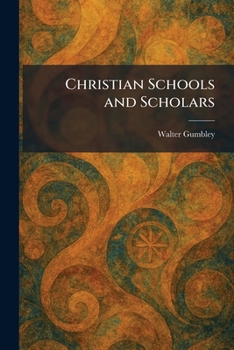
Christian Schools and Scholars

Select Format
Select Condition 
Book Overview
"Christian Schools and Scholars" provides an illuminating historical survey of the development of educational systems and the pursuit of knowledge within the Christian tradition. This work meticulously traces the evolution of learning from the early monastic foundations to the establishment of the great medieval universities, illustrating the central role the Church played in the preservation and dissemination of Western culture.
The narrative explores the lives and works of influential thinkers, theologians, and educators who sought to harmonize faith with intellectual inquiry. By examining the curriculum, teaching methods, and the social impact of these institutions, the author highlights how Christian scholarship laid the groundwork for modern academic life. From the quiet cloisters of the early Middle Ages to the vibrant debates of Scholasticism, the book showcases the enduring commitment to wisdom and the life of the mind.
Ideal for historians, educators, and students of religious history, "Christian Schools and Scholars" serves as a testament to the intellectual heritage of the Christian world. It offers a profound look at how schools functioned as centers of community and learning, shaping the moral and mental landscape of generations through the synthesis of religious devotion and academic rigor.
This work has been selected by scholars as being culturally important, and is part of the knowledge base of civilization as we know it. This work was reproduced from the original artifact, and remains as true to the original work as possible. Therefore, you may see the original copyright references, library stamps (as most of these works have been housed in our most important libraries around the world), and other notations in the work.
This work is in the public domain in the United States of America, and possibly other nations. Within the United States, you may freely copy and distribute this work, as no entity (individual or corporate) has a copyright on the body of the work.
As a reproduction of a historical artifact, this work may contain missing or blurred pages, poor pictures, errant marks, etc. Scholars believe, and we concur, that this work is important enough to be preserved, reproduced, and made generally available to the public. We appreciate your support of the preservation process, and thank you for being an important part of keeping this knowledge alive and relevant.
Customer Reviews
ThriftBooks ® and the ThriftBooks ® logo are registered trademarks of Thrift Books Global, LLC
