


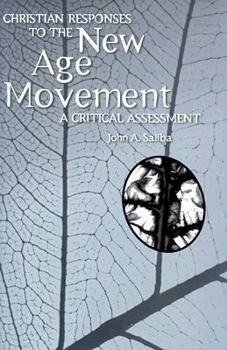
Christian Responses to the New Age Movement: A Critical Assessment


For Christians, the first encounter with the New Age Movement may prove confusing. On the one hand, there is an attraction in New Age ideology and ritual practice, but on the other, this very... This description may be from another edition of this product.
Format:Paperback
Language:English
ISBN:0225668521
ISBN13:9780225668520
Release Date:January 1999
Publisher:UNKNO
Length:245 Pages
Weight:1.00 lbs.
Dimensions:9.3" x 0.8" x 6.3"
Customer Reviews
2 ratings
Welcome Analysis
Published by Thriftbooks.com User , 25 years ago
John Saliba, a scholar in religious studies, has written a handsome survey of Christian responses to new age spirituality. Saliba's manuscript, which was completed in 1997, covers a wide range of views. These views include fundamentalist, evangelical, mainline Protestant, Eastern Orthodox and Roman Catholic. Whilst the scope of the survey is broad, it is by no means exhaustive.Saliba argues that a large percentage of Christian literature on new age constitutes a monologue or soliloquy. That is, Christians have largely spent their time talking amongst themselves about new age, but with very few forays at serious dialogue with new age writers. He documents how various apologists approach new age beliefs from a confessional or biblical standpoint. Most writers show that new age beliefs are largely incompatible with Christianity.Saliba expresses frustration with writers who offer a blanket condemnation of new age and thereby fail to see that new age offers some serious questions that Christians should grapple with. He is also equally impatient with those few writers who celebrate anything new age, without engaging in critical discernment.After surveying the spectrum of views, Saliba concludes his work by considering a few select theological issues, such as reincarnation, crystals and Christology. With respect to Christology Saliba suggests that there may be several different models Christians could explore in opening up dialogue with new age seekers.A few critical points should be noted. Firstly, Saliba does not really deal with the possible application of cross-cultural mission principles as a basis for more effective dialogue and apologetics. He does not explore how such a paradigm could be grounded in Scripture, such as the Mars Hill address of Acts 17.Secondly, there are some minor textual errors in need of correction. On p 60 Kerry McRoberts is referred to as "her" when in fact McRoberts is a male; on p 90 the author Lockhaas should read Lochhaas;on p112 Millikan is called an Anglican when he is in fact a minister in the Uniting Church in Australia.Lastly, although the coverage is generous, and acknowledging that the text was submitted back in 1997 for publication, the book is already in need of a fresh edition. For example Saliba needs to take notice of John Drane's What is the New Age Still Saying to the Church? (Harper Collins 1999); Ross Clifford & Philip Johnson, Sacred Quest (Albatross 1995); and John Newport, The New Age Movement and the Biblical Worldview (Eerdmans, 1998).Despite these shortcomings Saliba's book is to be commended. Christian apologists, whatever their theological commitments, would profit from grappling with this book.
A handsome survey and analysis of Christian views on New Age
Published by Thriftbooks.com User , 25 years ago
John Saliba presents a very useful, but by no means exhaustive, survey of Christian apologetic literature treating the New Age. The text begins with a sketch of what is the new age as viewed both by seekers and scholars. Saliba then surveys fundamentalist/evangelical, mainline Protestant, Eastern Orthodox and Roman Catholic responses. Although most authors surveyed are mainstream, he also includes controversial writers like Matthew Fox. His survey is current up to the mid 1990s and includes authors from Europe, Australia and North America.Saliba argues that many Christian texts about New Age are inaccurate and inadequate. He points out that whilst Christians should certainly understand and challenge New Age theologically, the stance taken by many Christians is undergirded by fear. He indicates that making doctrinal comparisons between Christian and New Age beliefs constitutes a monologue inside the Christian community. Although doctrinal comparisons may help clarify differences in belief, this approach scarcely stimulates any effective engagement with New Age. In other words, Christians need to take a further step of facing the critiques New Age presents to Christianity, as well as challenging some key weaknesses in New Age. Saliba concludes his book with some methodological issues and then explores several different models of Christology that might be fruitful in any sensible dialogue with New Age thinkers.This book will prove to be disconcerting for some readers who have relied on the apologists as their primary source of information about new age. However his critical analysis deserves to be examined, especially by those authors he treats. The tone of Saliba's treatment is courteous but firm. Saliba expresses frustration with writers who totally debunk new age and fail to find anything worthwhile in it. He is also impatient with those Christians who simply embrace anything new age and fail to discern its pitfalls.A few critical remarks about the book are in order. Saliba's book does not interact with Christian models of cross-cultural mission. He does not really address the specifics of how Christian evangelists or congregations could interact with seekers. He does offer guidelines about dialogue based particularly on inter-faith models. However it is a pity that his book, which was completed in 1997 but only published in 1999,has missed out on more recent works such as John Drane's What is the New Age Still Saying to the Church? (Marshall Pickering 1999) and Ross Clifford & Philip Johnson's, Sacred Quest (Albatross 1995). If Saliba had had access to these and other materials, his book would be worthy of a higher rating than that awarded here.The text also has a few minor typographical errors (e.g. "Don Rhodes" should read "Ron Rhodes" on p. 61; "Philip Lockhaas" should read "Philip Lochhaas" on p. 90). There are also factual errors (such as Kerry McRoberts is "he" not "her" on p.60; David Millikan is a
Copyright © 2026 Thriftbooks.com Terms of Use
| Privacy Policy | Do Not
Sell/Share My Personal Information | Cookie Policy | Cookie Preferences | Accessibility Statement
ThriftBooks® and the ThriftBooks® logo are registered trademarks of Thrift Books Global, LLC
ThriftBooks® and the ThriftBooks® logo are registered trademarks of Thrift Books Global, LLC
