


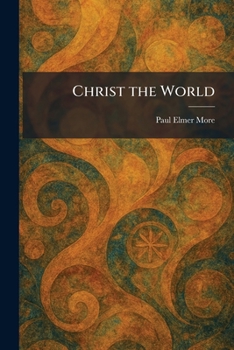
Christ the World

"Christ the World" is a profound exploration of the intersection between classical Greek philosophy and the foundational doctrines of Christianity. Written by the distinguished critic and philosopher Paul Elmer More, this work examines the development of the Logos concept and its central role in shaping the theological landscape of the early Church. More meticulously traces the evolution of intellectual thought from the Platonic tradition to the formalization of the Incarnation, arguing that the Christian revelation provides the necessary fulfillment of ancient philosophical pursuits.
The text focuses on the dual nature of Christ, situating historical debates within the context of early ecumenical councils. By analyzing the synthesis of Hellenic reason and Christian faith, More offers a compelling defense of orthodox Christology as a vital framework for understanding the relationship between the divine and the human. "Christ the World" serves as an essential resource for scholars and readers interested in the philosophical underpinnings of Western religion, providing a bridge between the classical mind and the mysteries of faith. More's insightful analysis emphasizes the historical and literary value of the Greek tradition as it informs the core tenets of the Christian worldview.
This work has been selected by scholars as being culturally important, and is part of the knowledge base of civilization as we know it. This work was reproduced from the original artifact, and remains as true to the original work as possible. Therefore, you may see the original copyright references, library stamps (as most of these works have been housed in our most important libraries around the world), and other notations in the work.
This work is in the public domain in the United States of America, and possibly other nations. Within the United States, you may freely copy and distribute this work, as no entity (individual or corporate) has a copyright on the body of the work.
As a reproduction of a historical artifact, this work may contain missing or blurred pages, poor pictures, errant marks, etc. Scholars believe, and we concur, that this work is important enough to be preserved, reproduced, and made generally available to the public. We appreciate your support of the preservation process, and thank you for being an important part of keeping this knowledge alive and relevant.
Customer Reviews
ThriftBooks ® and the ThriftBooks ® logo are registered trademarks of Thrift Books Global, LLC
