


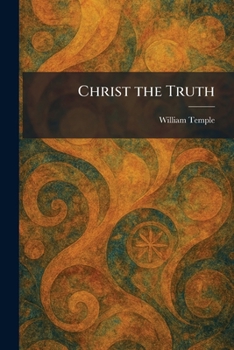
Christ the Truth

Select Format
Select Condition 
Book Overview
"Christ the Truth" is a profound work of systematic theology that explores the central figure of the Christian faith as the ultimate key to understanding reality. Written by William Temple, this treatise serves as a sequel to his earlier philosophical inquiries, aiming to provide a coherent vision of the universe through the lens of the Incarnation. Temple argues that Christ is not merely a historical figure or a moral teacher, but the living embodiment of truth that harmonizes the contradictions of human experience and the complexities of natural science and philosophy.
Throughout the text, Temple examines how the divine nature interacts with the physical world, offering insights into metaphysics, ethics, and the relationship between God and humanity. The work is characterized by its intellectual rigor and its attempt to bridge the divide between religious revelation and secular thought. By positioning the Person of Christ as the cornerstone of all knowledge, "Christ the Truth" offers a comprehensive framework for a Christian worldview. It remains an essential text for those interested in the development of modern Anglican thought, providing a powerful synthesis of faith, reason, and the pursuit of spiritual clarity in an increasingly complex world.
This work has been selected by scholars as being culturally important, and is part of the knowledge base of civilization as we know it. This work was reproduced from the original artifact, and remains as true to the original work as possible. Therefore, you may see the original copyright references, library stamps (as most of these works have been housed in our most important libraries around the world), and other notations in the work.
This work is in the public domain in the United States of America, and possibly other nations. Within the United States, you may freely copy and distribute this work, as no entity (individual or corporate) has a copyright on the body of the work.
As a reproduction of a historical artifact, this work may contain missing or blurred pages, poor pictures, errant marks, etc. Scholars believe, and we concur, that this work is important enough to be preserved, reproduced, and made generally available to the public. We appreciate your support of the preservation process, and thank you for being an important part of keeping this knowledge alive and relevant.
Customer Reviews
ThriftBooks ® and the ThriftBooks ® logo are registered trademarks of Thrift Books Global, LLC
