


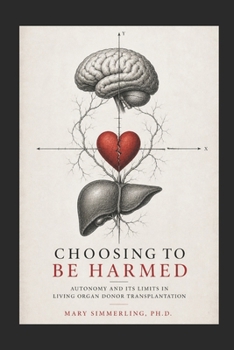
Choosing to be Harmed: Autonomy and its Limits in Living Organ Donor Transplantation

What does it mean to choose harm-for the sake of someone you love?
A mother offers a kidney to her son. A husband offers part of his liver to his wife. In the language of medical ethics, these are described as autonomous decisions: an individual weighs risks and benefits and consents. But anyone who has stood inside such a decision knows that this description is incomplete. The decision is not made at the point of consent. It emerges from commitments and relationships that precede it-love, obligation, responsibility, and the knowledge of what is at stake.
In Choosing to Be Harmed, philosopher Mary Simmerling takes up one of the most difficult problems in contemporary bioethics: how to understand decisions in which one person knowingly accepts risk, and even harm, for the sake of another. Using living organ donor transplantation as a case study, she shows that the dominant frameworks used to evaluate these decisions are not only incomplete, but structurally misaligned with the reality they are meant to describe.
Modern bioethics has centered autonomy as the foundation of decision-making. Within this model, individuals are understood to act independently, weighing risks and benefits and choosing freely. But in the context of living donation, this model begins to break down. Risks and benefits are distributed across persons. Decisions are made within relationships defined by attachment, obligation, and urgency. Emotion is treated as a distortion, even as it clarifies what matters most.
Simmerling argues that this framework fails in several critical ways. It excludes the risks of inaction-what is borne when one does not act. It collapses meaningful distinctions between coercion and commitment. It mischaracterizes emotion as a threat to rationality rather than a condition of it. And it overlooks the ways structural inequalities-race, class, gender, and access to care-shape who is able to give, and at what cost.
Those who present as donors do not arrive as isolated decision-makers. They arrive embedded in relationships, histories, and material conditions that shape both what they can choose and what those choices mean. To treat their decisions as if they were made in isolation is not to protect them. It is to misunderstand them.
Originally written as a doctoral dissertation and returned to twenty years later, Choosing to Be Harmed brings together rigorous philosophical analysis and lived experience. It offers a relational account of autonomy that takes seriously the realities of love, obligation, and loss, and calls for a rethinking of how ethical decision-making in medicine is understood when it cannot be reduced to a model.
This is a book for clinicians, ethicists, and philosophers. It is also a book for anyone who has faced a decision that could not be made on a worksheet-and knew it.
Customer Reviews
ThriftBooks ® and the ThriftBooks ® logo are registered trademarks of Thrift Books Global, LLC
