




Select Format
Select Condition 
Book Overview
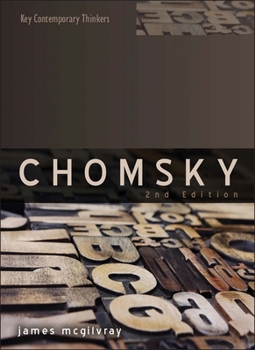
Noam Chomsky has made major contributions to three fields: political history and analysis, linguistics, and the philosophies of mind, language, and human nature. In this thoroughly revised and updated volume, James McGilvray provides a critical introduction to Chomsky's work in these three key areas and assesses their continuing importance and relevance for today.
In an incisive and comprehensive analysis, McGilvray argues that Chomsky's work can be seen as a unified intellectual project. He shows how Chomsky adapts the tools of natural science to the study of mind and of language in particular and explains why Chomsky's "rationalist" approach to the mind continues to be opposed by the majority of contemporary cognitive scientists. The book also discusses some of Chomsky's central political themes in depth, examining how Chomsky's view of the good life and the ideal form of social organization is related to and in part dependent on his biologically based account of human nature and the place of language within it. As in the first edition, McGilvray emphasizes the distinction between common sense and science and the difference between rationalist and empiricist approaches to the mind, making clear the importance of these themes for understanding Chomsky's work and showing that they are based on elementary observations that are accessible to everyone. This edition has been extensively re-written to emphasize Chomsky's recent work, which increasingly 'biologizes' the study of language and mind and - by implication - the study of human nature.
This book will be of interest to students and scholars of philosophy, linguistics, and politics, as well as to all those keen to develop a critical understanding of one of the most controversial and important thinkers writing today.
In an incisive and comprehensive analysis, McGilvray argues that Chomsky's work can be seen as a unified intellectual project. He shows how Chomsky adapts the tools of natural science to the study of mind and of language in particular and explains why Chomsky's "rationalist" approach to the mind continues to be opposed by the majority of contemporary cognitive scientists. The book also discusses some of Chomsky's central political themes in depth, examining how Chomsky's view of the good life and the ideal form of social organization is related to and in part dependent on his biologically based account of human nature and the place of language within it. As in the first edition, McGilvray emphasizes the distinction between common sense and science and the difference between rationalist and empiricist approaches to the mind, making clear the importance of these themes for understanding Chomsky's work and showing that they are based on elementary observations that are accessible to everyone. This edition has been extensively re-written to emphasize Chomsky's recent work, which increasingly 'biologizes' the study of language and mind and - by implication - the study of human nature.
This book will be of interest to students and scholars of philosophy, linguistics, and politics, as well as to all those keen to develop a critical understanding of one of the most controversial and important thinkers writing today.
Format:Paperback
Language:English
ISBN:0745649904
ISBN13:9780745649900
Release Date:November 2013
Publisher:Polity Press
Length:288 Pages
Weight:0.90 lbs.
Dimensions:0.9" x 5.9" x 8.9"
Customer Reviews
1 rating
Solid overview of many of Chomsky's ideas
Published by Thriftbooks.com User , 22 years ago
This book gives a good overview of much of Chomsky's life work in linguistics, philosophy and politics. What it is not is an introduction into those topics, but neither is it written in a style that is overly academic. McGilvray seeks to integrate Chomsky's linguistic and political work somewhat and with a small amount of success, suggesting that they are intertwined and of course they are to a vague degree. That angle is interesting in its own way, but luckily the author does not force his hypothesis too much, instead he does a rather good job of overviewing and summarizing the main emphases of Chomsky's work in a cohesive and enlightening fashion. Probably not a necessary read for those who have read a lot of Chomsky's own works in both fields, but for those who haven't, or for people who simply enjoy reading in politics, philosophy and/or linguistics this book should make for interesting study.
Copyright © 2026 Thriftbooks.com Terms of Use
| Privacy Policy | Do Not
Sell/Share My Personal Information | Cookie Policy | Cookie Preferences | Accessibility Statement
ThriftBooks® and the ThriftBooks® logo are registered trademarks of Thrift Books Global, LLC
ThriftBooks® and the ThriftBooks® logo are registered trademarks of Thrift Books Global, LLC
