


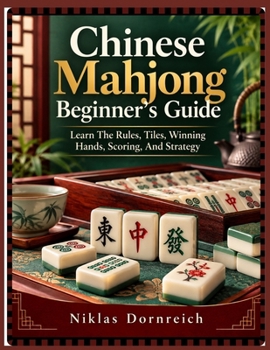
Chinese Mahjong Beginner's Guide: Learn The Rules, Tiles, Winning Hands, Scoring, And Strategy

NEW TO CHINESE MAHJONG AND NOT SURE WHERE TO START?
The tiles look unfamiliar. The rules seem complicated. You are trying to understand what to keep, what to discard, when to call, how a winning hand is formed, and why the scoring seems different from one table to another.
Chinese Mahjong Beginner's Guide is designed to take you from those first questions to a much clearer understanding of how the game actually works.
Instead of asking you to memorize a long list of rules before you ever play, this guide builds your knowledge step by step. You will first learn to recognize the Mahjong tiles and understand the three numbered suits, Winds, Dragons, Flowers, and Seasons. Then you will learn how the table is prepared, how the walls are built, how players receive their starting hands, and how a typical game begins.
As you progress, you will learn how a Mahjong turn works, how drawing and discarding affect your hand, and how to recognize useful relationships between tiles.
Inside, you will learn how to:
- Identify and organize Mahjong tiles with greater confidence
- Understand Characters, Bamboos, Dots, Winds, and Dragons
- Set up a four-player Mahjong table
- Understand the basic draw-and-discard rhythm
- Build a hand using sequences, triplets, kongs, and pairs
- Recognize possible winning tiles and developing combinations
- Understand Chow, Pung, Kong, melds, concealed hands, exposed hands, and discards
- Make more thoughtful discard and calling decisions
- Understand how winning declarations work
- Approach Mahjong scoring without assuming every table uses identical rules
- Understand minimum-value requirements, flowers, kongs, payments, and other ruleset-dependent elements
- Recognize dangerous discards and observe information revealed by other players
- Develop practical beginner strategy instead of relying on rigid rules
- Adjust your plan when new tiles change the direction of your hand
- Practice decision-making through realistic game situations
- Recognize common beginner mistakes and learn how to improve
- Build the confidence to sit down at the table and make your own decisions
One of the most important ideas in this book is that Mahjong is not simply about collecting matching tiles. Your hand changes with every draw and discard, while the other players are making their own decisions. Learning to recognize those changes is part of learning to play.
You will also learn why Mahjong rules and scoring cannot always be assumed to be identical from one table to another. The book explains how to approach rule variations, scoring systems, flowers, minimum requirements, and house rules so you can establish the rules before playing and avoid unnecessary confusion.
Whether you are preparing for your first complete game, trying to understand the tiles in front of you, or looking for a clearer way to think about discards, calls, winning hands, and strategy, this guide gives you a structured place to begin.
Learn the tiles. Understand the rules. Build your hand. Think through your decisions. Then take what you have learned to the table.
Customer Reviews
ThriftBooks ® and the ThriftBooks ® logo are registered trademarks of Thrift Books Global, LLC
