


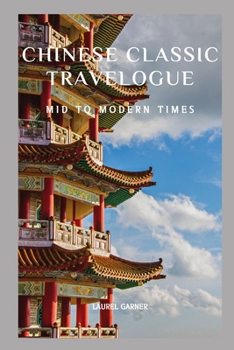
Chinese Classic Travelogue: Mid to Modern Times
No Customer Reviews

To understand the history of Chinese prose, one must begin with its earliest beginnings. The earliest forms of Chinese prose can be traced back to the period of the Eastern Zhou dynasty (770-256 BC). The rise of Confucianism during this time had a profound impact on Chinese literature, as the Confucian classics were written in prose. These works, which include the Analects of Confucius, the Mencius, and the Doctrine of the Mean, are still considered to be some of the greatest works of Chinese literature.
During the Han dynasty (206 BC - 220 AD), Chinese prose continued to evolve, as writers began to experiment with new literary forms. One of the most important of these forms was the historical record, which was first used to chronicle the deeds of the Han emperors. These records, which were compiled by court historians, included detailed accounts of the lives of the emperors, as well as descriptions of the major events of their reigns.
The Tang dynasty (618-907 AD) is considered to be the golden age of Chinese literature, and it was during this time that many of the greatest works of Chinese prose were written. One of the most famous writers of this period was Han Yu, who is considered to be the founder of the essay form. Han Yu's essays were written in a clear, concise style, and he used them to express his views on a wide range of subjects, from politics to literature.
During the Song dynasty (960-1279 AD), Chinese prose continued to evolve, as writers began to experiment with new forms and styles. One of the most important of these forms was the travelogue, which was used to describe the experiences of Chinese travelers as they journeyed through foreign lands. One of the most famous travelogues of this period was the Record of a Journey to the West, written by the Buddhist monk Xuanzang, who traveled to India in search of Buddhist scriptures.
In the Qing dynasty (1644-1912 AD), Chinese prose continued to evolve, as writers began to experiment with new forms and styles. One of the most important of these forms was the vernacular novel, which was written in the everyday language of the people. The most famous vernacular novel of this period is the Dream of the Red Chamber, written by Cao Xueqin, which tells the story of a noble family during the Qing dynasty.
In conclusion, the history of Chinese prose is a rich and complex one, spanning over two thousand years of literary evolution. From the earliest works of the Eastern Zhou dynasty to the vernacular novels of the Qing dynasty, Chinese prose has continued to evolve and adapt, reflecting the changing times and values of the Chinese people. A deeper understanding of this literary tradition is essential for anyone seeking to understand the rich and diverse culture of China.
It is true that the problems of definition and selection make it difficult to provide a comprehensive inventory of Chinese prose. The blurred boundaries between literature, history, and philosophy in Chinese culture make it challenging to draw clear distinctions between different genres. Additionally, the sheer breadth of Chinese literary tradition, spanning over two thousand years, means that it is impossible to cover everything in detail.
In conclusion, while a comprehensive inventory of Chinese prose may be impossible, scholars can still make valuable contributions to our understanding of this rich and complex literary tradition by focusing on specific genres, periods, and themes. By remaining open-minded and attentive to the nuances of Chinese culture, we can continue to deepen our appreciation of this important aspect of world literature.
During the Han dynasty (206 BC - 220 AD), Chinese prose continued to evolve, as writers began to experiment with new literary forms. One of the most important of these forms was the historical record, which was first used to chronicle the deeds of the Han emperors. These records, which were compiled by court historians, included detailed accounts of the lives of the emperors, as well as descriptions of the major events of their reigns.
The Tang dynasty (618-907 AD) is considered to be the golden age of Chinese literature, and it was during this time that many of the greatest works of Chinese prose were written. One of the most famous writers of this period was Han Yu, who is considered to be the founder of the essay form. Han Yu's essays were written in a clear, concise style, and he used them to express his views on a wide range of subjects, from politics to literature.
During the Song dynasty (960-1279 AD), Chinese prose continued to evolve, as writers began to experiment with new forms and styles. One of the most important of these forms was the travelogue, which was used to describe the experiences of Chinese travelers as they journeyed through foreign lands. One of the most famous travelogues of this period was the Record of a Journey to the West, written by the Buddhist monk Xuanzang, who traveled to India in search of Buddhist scriptures.
In the Qing dynasty (1644-1912 AD), Chinese prose continued to evolve, as writers began to experiment with new forms and styles. One of the most important of these forms was the vernacular novel, which was written in the everyday language of the people. The most famous vernacular novel of this period is the Dream of the Red Chamber, written by Cao Xueqin, which tells the story of a noble family during the Qing dynasty.
In conclusion, the history of Chinese prose is a rich and complex one, spanning over two thousand years of literary evolution. From the earliest works of the Eastern Zhou dynasty to the vernacular novels of the Qing dynasty, Chinese prose has continued to evolve and adapt, reflecting the changing times and values of the Chinese people. A deeper understanding of this literary tradition is essential for anyone seeking to understand the rich and diverse culture of China.
It is true that the problems of definition and selection make it difficult to provide a comprehensive inventory of Chinese prose. The blurred boundaries between literature, history, and philosophy in Chinese culture make it challenging to draw clear distinctions between different genres. Additionally, the sheer breadth of Chinese literary tradition, spanning over two thousand years, means that it is impossible to cover everything in detail.
In conclusion, while a comprehensive inventory of Chinese prose may be impossible, scholars can still make valuable contributions to our understanding of this rich and complex literary tradition by focusing on specific genres, periods, and themes. By remaining open-minded and attentive to the nuances of Chinese culture, we can continue to deepen our appreciation of this important aspect of world literature.
Format:Paperback
Language:English
ISBN:B0BXNN42YH
ISBN13:9798386652289
Release Date:March 2023
Publisher:Independently Published
Length:690 Pages
Weight:2.00 lbs.
Dimensions:1.4" x 6.0" x 9.0"
Related Subjects
HistoryCustomer Reviews
0 rating
Copyright © 2026 Thriftbooks.com Terms of Use
| Privacy Policy | Do Not
Sell/Share My Personal Information | Cookie Policy | Cookie Preferences | Accessibility Statement
ThriftBooks® and the ThriftBooks® logo are registered trademarks of Thrift Books Global, LLC
ThriftBooks® and the ThriftBooks® logo are registered trademarks of Thrift Books Global, LLC
