


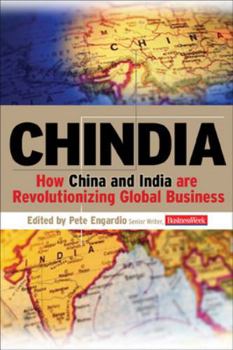
Chindia: How China and India Are Revolutionizing Global Business


The best minds at BusinessWeek explore ways your company can survive-and thrive-amid the business growth and innovation of China and India
The economic rise of China and India has changed the way the world does business-and today's companies need to step up their game. This in-depth report, edited by a senior writer at BusinessWeek, goes behind the headlines of the new "megamarkets" to explore how your company can stay competitive. With a diverse array of viewpoints, ideas, and forward-thinking strategies, Chindia discusses new avenues businesses can use to embrace change and encourage growth.
Brings together reporting and analysis on China's and India's emerging markets, from the reporters of the world's most widely read business magazineProvides need-to-know information for you to plan for the future of your businessFeatures an introduction from Engardio, as well as chapter introductions explaining how the stories fit together and concluding summaries of major points for each chapterFormat:Paperback
Language:English
ISBN:0071476571
ISBN13:9780071476577
Release Date:November 2006
Publisher:McGraw-Hill Education
Length:224 Pages
Weight:1.15 lbs.
Dimensions:1.0" x 6.1" x 9.0"
Customer Reviews
3 ratings
India predicted to pass China GDP
Published by Thriftbooks.com User , 19 years ago
1. China and India share many characteristics as future growth markets: immense upwardly mobility, an emerging middle class whose aspirations and outlook on life differ from those of the previous generation. Rapid social changes and greater diversity means companies must employee more sophistication in tailoring their message and products to a different consumer segment. 2. Automotive: GM enjoyed success selling Buick Regal which starts at $25,138, partnering with SAIC to sell the $8,000 spark, and expanding the XLR Cadillac line. "One thing you learn in China is that you have to move fast" says, Kevin Wale. 3. Elantra compact, starting at $13,600, Hyundai Motor Co's unit sales in China Soared 156% in the first quarter 2005. 4. Honda's fit sold 76% more cars as buyers snapped up its $10,360 fit. 5. Domestic car Chery QQ had explosive response to its $3,600 price tag. 6. GM SAIC venture plummeted 35% and overall profits plummeted 80% to $33 million. Today most buyers are individual and they want the best deal for their money. "And rumors that Beijing is mulling a tax on vehicles with big engines are only accelerating the trend". 7. Nissan plans to add 250 new dealerships to its existing 500 dealerships by 2007. 8. Ford plans to invest $1 billion in China. 9. VW sells a $9,000 Golf and a $12,000 polo in China, 10. "Price for GM and Volkswagen are still to high" cautions Jia Xinguang. 11. Chinese Basic values: 1. individualism: 2/3 of young Chinese prefer to do things themselves, rather than rely on others. 2. lifestyle: 39% are happy with life, 18% say they have enough money, 59% say they need to take risks to be successful, and for consumer product companies this means a huge desire for new trends. 3. Career: 80% are working hard for their career 4. Liberating women: men should do housework. 5. Internationalism: 2/3 says they are interested in other cultures, but they don't walk the talk. 6. Knowledge: 75% says its important to be well informed. 7. Spirituality: There is a growing demand for spiritual experiences. 51% will still sacrifice leisure for money. 8. Social: Young Chinese care about environment, charity, and public interests in general than older Chinese. 12. Most Chinese homes have been converted from coal to natural gas 13. $13 billion will go to prepare for the Olympics 14. China spent $85 billion in cleanup since 2000 and will spend $380 billion until 2010. 15. Over 400 non-Chinese companies now sell pollution-control equipment in China. 16. A good internal rate of return in China is 12%. Jorge Mora, Veolia expects 20%-25% growth in China investment of $800 million. 17. India model is characterized by strength in engineering and services, private capital markets, business models that focus on high-quality goods and services at low cost, and small-batch precision manufacturing. 18. 1/3 of the world population, China has been growing by 9.5% a year and India by 6%. "Given their young populations and hi
A Fascinating View of Two Huge Economies
Published by Thriftbooks.com User , 19 years ago
This book provides a look at the growth of the economies of China and India. The book looks at what is going right in both countries and also looks at the big problems facing them (think: poor education, unequal distribution of wealth, government corruption, intellectual property theft, etc.). In places the book is rather gloomy, particuarly when talking about the loss of jobs in the United States to these countries. In other spots, the book hits the weaknesses of these economic powerhouses right on the head. The book often gives personal stories of people in these countries who have seen their lives changed by the economic growth of India and China, and many of these stories are fascinating and even touching. All in all, this is a book that is well worth reading.
A must read for all CEO!!!
Published by Thriftbooks.com User , 19 years ago
China manufacturing and India Information Technology are winning the world stage. With 2.3 billion customers, it is a major market to reckon with. The middle class is doing well in both countries. Using IT as a base, outsourcing, call centers, e-leader in villages, ICICI bank micro finance to the millions of poor, computerized land record, tech innovation become the strength of India. Tata Consulting Services, Wipro, Infosys, Satyam are becoming household names. Tata Motor learned much from Toyota Motor. Indian Institute Technology and Manipal Inst Technology (the other MIT) are just a few of the hundreds of world-class institutions that turned out the best and the brightest students in India. They work on Wall Street, Silicon Valley and become CEOs of their own firms. Problems? Too many people with few teachers in India. Teacher salary is very low and curriculum needs overhaul. Most Indians earn $1 per day. Foreign direct investment (FDI) in India is only $6 bn USD. For China, FDI is $60 bn USD in 2006. Hu Jintao and Wen Jiabao took over 2003. With foreign reserve almost $1 trillion USD, China buys everything from everyone. Veolia Environment (a French firm) invested $800 million in 10 water-treatment projects and profited well. Proctor and Gamble did wel with 4 factories. Cummins Engine found the niche. Autos: VW is now only 25%, GM is less, difficult to compete with Honda, Hyundai, local brand Chery. Steel, chemical, TV, cell phones, PC, DVD, the list goes on and on. In each one of these areas, there is always Chinese competition. TCL is winning the TV war vs Sony, Panasonic and Samsung. Motorola competes with Nokia and many other locals. Oil business, PetroChina, China National Petroleum Corp, and CNOOC are all owned by the Chinese government. 200 large state companies control oil, gas, telecom, steel, coal, and many other core industries. As more US banks buy shares of the China banks, the growth potential is unlimited. But it also comes with many debt transparency issues. Historically, India and China never worked together. If they do, I believe it is mutually beneficial. Indians learned from the British with strong IT and finance experience. Chinese are operational and manufacturing experts. That day may come very soon. In each chapter, it moves back and forth from China to India, making it difficult to flow. This book will be better if it explains one country at a time. Still, the book is very informative and I will recommend this book to all CEOs.
Copyright © 2026 Thriftbooks.com
Terms of Use | Privacy Policy | Do Not Sell/Share My Personal Information | Cookie Notice | Cookie Preferences | Accessibility Statement
ThriftBooks ® and the ThriftBooks ® logo are registered trademarks of Thrift Books Global, LLC
ThriftBooks ® and the ThriftBooks ® logo are registered trademarks of Thrift Books Global, LLC
