


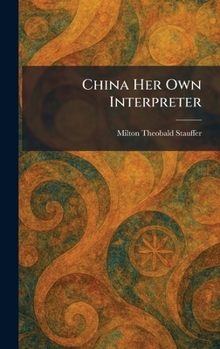
China Her Own Interpreter

"China Her Own Interpreter" is a compelling collection of essays that provides a unique perspective on the social, political, and spiritual state of China during the early 20th century. Edited by Milton Theobald Stauffer, this work brings together the voices of Chinese intellectuals and leaders to explain their country's complex transformation from their own viewpoint rather than through a Western lens.
The chapters explore a wide range of topics, including the challenges of rising nationalism, the evolution of the Chinese church, and the intersection of traditional cultural values with modern religious thought. By prioritizing indigenous perspectives, the volume offers a critical look at how China viewed its own destiny amidst a period of significant upheaval and foreign influence. It serves as an essential historical document for understanding the development of local leadership within the global missionary movement and the broader struggle for national identity.
Readers will find profound insights into the aspirations and challenges of the Chinese people during the late 1920s. This work remains a valuable resource for students of Asian history, missiology, and the history of international religious movements, capturing a pivotal moment when China sought to define itself on the world stage.
This work has been selected by scholars as being culturally important, and is part of the knowledge base of civilization as we know it. This work was reproduced from the original artifact, and remains as true to the original work as possible. Therefore, you may see the original copyright references, library stamps (as most of these works have been housed in our most important libraries around the world), and other notations in the work.
This work is in the public domain in the United States of America, and possibly other nations. Within the United States, you may freely copy and distribute this work, as no entity (individual or corporate) has a copyright on the body of the work.
As a reproduction of a historical artifact, this work may contain missing or blurred pages, poor pictures, errant marks, etc. Scholars believe, and we concur, that this work is important enough to be preserved, reproduced, and made generally available to the public. We appreciate your support of the preservation process, and thank you for being an important part of keeping this knowledge alive and relevant.
Customer Reviews
ThriftBooks ® and the ThriftBooks ® logo are registered trademarks of Thrift Books Global, LLC
