


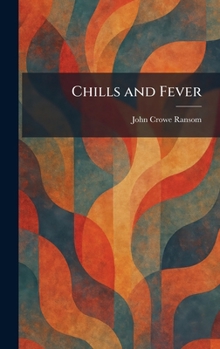
Chills and Fever

"Chills and Fever" is a seminal collection of modernist poetry by the distinguished American poet and critic John Crowe Ransom. This volume established Ransom as a pivotal voice in the Southern Renaissance and a progenitor of the New Criticism movement. The poems within are characterized by their formal precision, sharp wit, and a sophisticated use of irony that bridges the gap between traditional sentiment and modern intellectual skepticism.
Ransom's verse explores themes of mortality, the complexities of human relationships, and the inherent tensions between the mind and the body. Through his unique mastery of tone and diction, he transforms domestic scenes and regional settings into profound meditations on the human condition. Notable for its rhythmic grace and structural rigor, "Chills and Fever" remains an essential work for readers of 20th-century literature and those interested in the evolution of American poetic craft. This collection represents a significant milestone in the development of modern lyricism, offering a blend of classical restraint and poignant emotional depth that continues to resonate with contemporary audiences.
This work has been selected by scholars as being culturally important, and is part of the knowledge base of civilization as we know it. This work was reproduced from the original artifact, and remains as true to the original work as possible. Therefore, you may see the original copyright references, library stamps (as most of these works have been housed in our most important libraries around the world), and other notations in the work.
This work is in the public domain in the United States of America, and possibly other nations. Within the United States, you may freely copy and distribute this work, as no entity (individual or corporate) has a copyright on the body of the work.
As a reproduction of a historical artifact, this work may contain missing or blurred pages, poor pictures, errant marks, etc. Scholars believe, and we concur, that this work is important enough to be preserved, reproduced, and made generally available to the public. We appreciate your support of the preservation process, and thank you for being an important part of keeping this knowledge alive and relevant.
Customer Reviews
ThriftBooks ® and the ThriftBooks ® logo are registered trademarks of Thrift Books Global, LLC
