


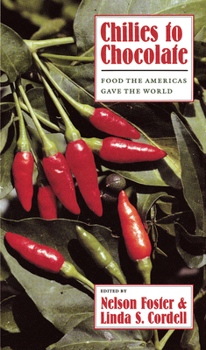
Chilies to Chocolate: Food the Americas Gave the World


Select Format
Select Condition 
Book Overview
Columbus stumbled upon the New World while seeking the riches of the orient, yet native peoples of the Americas already held riches beyond his knowing. From maize to potatoes to native beans, a variety of crops unfamiliar to Europeans were cultivated by indigenous peoples of the Americas, with other foods like chilies and chocolate on hand to make diets all the more interesting (even when used in combination, as aficionados of mol will attest). Chilies to Chocolate traces the biological and cultural history of some New World crops that have worldwide economic importance. Drawing on disciplines as diverse as anthropology, ethnobotany, and agronomy, it focuses on the domestication and use of these plants by native peoples and their dispersion into the fields and kitchens of the Old World: tomatoes to Italy, chili peppers throughout Asia, cacao wherever a sweet tooth craves chocolate. Indeed, potatoes and maize now rank with wheat and rice as the world's principal crops. "The sweetness of corn on the cob is sweeter for knowing the long, winding way by which it has come into one's hands," observe Foster and Cordell. Featuring contributions by Gary Nabhan, Alan Davidson, and others, Chilies to Chocolate will increase readers' appreciation of the foods we all enjoy, of the circuitous routes by which they have become part of our diets, and of the vital role that Native Americans have played in this process. CONTENTS
Introduction, by Nelson Foster & Linda S. Cordell
1. Europeans' Wary Encounter with Tomatoes, Potatoes, and Other New World Foods, by Alan Davidson
2. The Renaissance of Amaranth, by Daniel K. Early
3. Vanilla: Nectar of the Gods, by Patricia Rain
4. Maize: Gift from America's First Peoples, by Walton C. Galinat
5. Beans of the Americas, by Lawrence Kaplan & Lucille N. Kaplan
6. The Peripatetic Chili Pepper: Diffusion of the Domesticated Capsicums Since Columbus, by Jean Andrews
7. Forgotten Roots of the Incas, by Noel Vietmeyer
8. A Brief History and Botany of Cacao, by John A. West
9. Quinoa's Roundabout Journey to World Use, by John F. McCamant
Epilogue: Native Crops of the Americas: Passing Novelties or Lasting Contributions to Diversity? by Gary Paul Nabhan
Appendix: Food Plants of American Origin
Introduction, by Nelson Foster & Linda S. Cordell
1. Europeans' Wary Encounter with Tomatoes, Potatoes, and Other New World Foods, by Alan Davidson
2. The Renaissance of Amaranth, by Daniel K. Early
3. Vanilla: Nectar of the Gods, by Patricia Rain
4. Maize: Gift from America's First Peoples, by Walton C. Galinat
5. Beans of the Americas, by Lawrence Kaplan & Lucille N. Kaplan
6. The Peripatetic Chili Pepper: Diffusion of the Domesticated Capsicums Since Columbus, by Jean Andrews
7. Forgotten Roots of the Incas, by Noel Vietmeyer
8. A Brief History and Botany of Cacao, by John A. West
9. Quinoa's Roundabout Journey to World Use, by John F. McCamant
Epilogue: Native Crops of the Americas: Passing Novelties or Lasting Contributions to Diversity? by Gary Paul Nabhan
Appendix: Food Plants of American Origin
Format:Paperback
Language:English
ISBN:0816513244
ISBN13:9780816513246
Release Date:July 1992
Publisher:University of Arizona Press
Length:191 Pages
Weight:0.62 lbs.
Dimensions:0.6" x 5.0" x 8.5"
Customer Reviews
2 ratings
Good review of American food history
Published by Thriftbooks.com User , 17 years ago
This is a good look into some of the history American food. Primarily focusing on the assimilation of specific foods into European and Asia culture via the New World exploration. Some information about the native American use of these foods as well. Foods of interest include: vanilla, amaranth, chili peppers and cacao.
Packs a Lot Into a Small Volume
Published by Thriftbooks.com User , 22 years ago
This book is just what it purports to be in the preface: a series of stand-alone articles taken from a program presented at the American Academy of Sciences. Therefore, it is not a comprehensive treatment of all foods from the Americas. What it does cover are in-depth chapters on various American foods that the authors deem to be most important, especially in the future. While I didn't find the book difficult to put down between readings, I was always eager to pick it up again.I am listing the chapter titles here because I think they are an excellent representation of what is actually covered in the book: Europeans' Wary Encounter with Tomatoes, Potatoes, and Other New World Foods; The Renaissance of Amaranth; Vanilla, the Nectar of the Gods; Maize, the Gift from America's First Peoples; Beans of the Americas; The Chili Pepper, and Diffusion of the Domesticated Capsicums Since Columbus; Forgotten Roots (plant roots) of the Incas; The History and Botany of Cacao; Quinoa's Roundabout Journey to World Use; and the Epilogue: Native Crops of the Americas, Passing Novelties, or Lasting Contributions to Diversity.The book could have been improved by a short section of color photographs of the plants discussed, showing what they are, and how they grow. I didn't know what amaranth was, and had to look it up elsewhere. Even though I have eaten quinoa, other people might not know what it is. But to be fair, the authors come right out and say that this book is far from a comprehensive treatment, and they assume that interested readers can do supplementary research on their own (very easy with an on-line encyclopaedia).I began this book with a fair background knowledge of the subject; yet, I learned a lot of new information. Some of the most interesting things I learned were many new facts about vanilla; about the two major pathways by which corn was domesticated, and the naming of various corn stalks; how quinoa came to be first grown in Colorado, as the first place outside of the Andes; why quinoa was difficult to grow in Colorado, in spite of it being a high-altitude crop; and about many other interesting and potentially useful root crops from the Andes, which I had never heard of.
Copyright © 2026 Thriftbooks.com
Terms of Use | Privacy Policy | Do Not Sell/Share My Personal Information | Cookie Policy | Cookie Preferences | Accessibility Statement
ThriftBooks ® and the ThriftBooks ® logo are registered trademarks of Thrift Books Global, LLC
ThriftBooks ® and the ThriftBooks ® logo are registered trademarks of Thrift Books Global, LLC
