


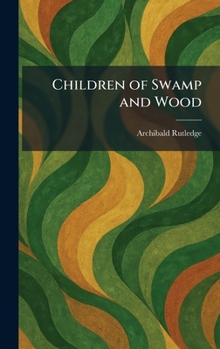
Children of Swamp and Wood

Select Format
Select Condition 
Book Overview
"Children of Swamp and Wood" is an evocative exploration of the mysterious and beautiful landscapes of the American South. This collection of sketches and observations offers a profound look at the wildlife that inhabits the deep swamps and ancient woodlands of the coastal regions. Through vivid prose and keen observation, the work brings to life the "children" of these wild places-from the elusive white-tailed deer and the majestic wild turkey to the stealthy predators that roam the riverbanks.
The work transcends simple nature reporting, blending scientific observation with a poetic sensibility that captures the spirit of the wilderness. The author explores the intricate relationships between animals and their environment, reflecting on the dignity of wild creatures and the timeless rhythms of the natural world. Readers are invited into a realm of cypress knees, moss-draped oaks, and hidden waterways, where the struggle for survival is balanced by moments of serene beauty. "Children of Swamp and Wood" remains a classic piece of American nature writing, offering a window into a pristine wilderness and celebrating the enduring power of the great outdoors. It is a vital read for anyone interested in natural history, Southern lore, or the art of the outdoor essay.
This work has been selected by scholars as being culturally important, and is part of the knowledge base of civilization as we know it. This work was reproduced from the original artifact, and remains as true to the original work as possible. Therefore, you may see the original copyright references, library stamps (as most of these works have been housed in our most important libraries around the world), and other notations in the work.
This work is in the public domain in the United States of America, and possibly other nations. Within the United States, you may freely copy and distribute this work, as no entity (individual or corporate) has a copyright on the body of the work.
As a reproduction of a historical artifact, this work may contain missing or blurred pages, poor pictures, errant marks, etc. Scholars believe, and we concur, that this work is important enough to be preserved, reproduced, and made generally available to the public. We appreciate your support of the preservation process, and thank you for being an important part of keeping this knowledge alive and relevant.
Customer Reviews
ThriftBooks ® and the ThriftBooks ® logo are registered trademarks of Thrift Books Global, LLC
