


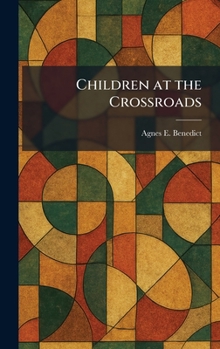
Children at the Crossroads

"Children at the Crossroads" is a compelling sociological study that examines the challenges facing rural youth in early 20th-century America. Written by Agnes E. Benedict, this work focuses on the innovative visiting teacher programs that sought to bridge the gap between the home and the schoolhouse for children struggling with behavioral, social, and academic issues.
Through a series of detailed case narratives, the book provides an intimate look at the lives of children in country districts, exploring the impact of poverty, isolation, and complex family dynamics on their development. Benedict illustrates how empathetic social work and personalized educational interventions can provide a "crossroads" where a child's trajectory can be redirected toward success. This volume serves as a vital historical document for those interested in the evolution of school social work, the history of education, and the development of child welfare practices in the United States.
With its focus on the human element of social reform, "Children at the Crossroads" remains an insightful resource for understanding the roots of modern educational support systems and the perennial struggle to ensure every child has the opportunity to thrive, regardless of their geographic or economic circumstances.
This work has been selected by scholars as being culturally important, and is part of the knowledge base of civilization as we know it. This work was reproduced from the original artifact, and remains as true to the original work as possible. Therefore, you may see the original copyright references, library stamps (as most of these works have been housed in our most important libraries around the world), and other notations in the work.
This work is in the public domain in the United States of America, and possibly other nations. Within the United States, you may freely copy and distribute this work, as no entity (individual or corporate) has a copyright on the body of the work.
As a reproduction of a historical artifact, this work may contain missing or blurred pages, poor pictures, errant marks, etc. Scholars believe, and we concur, that this work is important enough to be preserved, reproduced, and made generally available to the public. We appreciate your support of the preservation process, and thank you for being an important part of keeping this knowledge alive and relevant.
Customer Reviews
ThriftBooks ® and the ThriftBooks ® logo are registered trademarks of Thrift Books Global, LLC
