


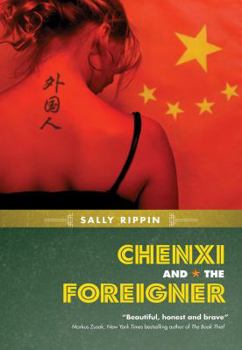
Chenxi and the Foreigner


Select Format
Select Condition 
Book Overview
Love in the time of the Tiananmen Square. Anna never imagined living in such a foreign place. Fresh out of high school, she has joined her father, who works in Shanghai. She's eager to see China... This description may be from another edition of this product.
Format:Paperback
Language:English
ISBN:1554511720
ISBN13:9781554511723
Release Date:February 2009
Publisher:Annick Press
Length:208 Pages
Weight:0.45 lbs.
Dimensions:7.3" x 0.6" x 5.0"
Age Range:14 to 18 years
Grade Range:Grade 9 to Postsecondary
Customer Reviews
2 ratings
Better than reading a travel guide
Published by Thriftbooks.com User , 16 years ago
Given the title, you would think Chenxi would be the main character of this book. And given that the first chapter is his, you would expect to get to know him in this story and watch him develop. Throughout the book, however, Chenxi remains as much a mystery to us as he does to Anna. Chenxi is a young man who seems extremely intelligent, who likes to try to outsmart people and is caught up in the world of foreigners in Shanghai and we only learn more on a need to know basis. Probably because his English is so good, he is requested to chaperone Anna while she visits with her dad, Mr. White. Mr. White's world is well,...white. He avoids mingling with Chinese culture while he lives and works there. Anna will be studying art at a nearby university, where he skills are quickly seen to be superior to the local students who are taught to paint with precision, void of emotion or individual interpretation. The art classes result from the author's 3 years in China taking art lessons. "Anna strained to see who was calling, but a hundred identical faces stared at her." I read this line, The Ultimate Racial Slur, and wanted to stop reading. I couldn't tell if this was the author's voice bleeding through or if this was the character's stupidity. It was the character and she was stupid! This story takes place in China in the 1980s and the reviews I've read felt that the author accurately captured Shanghai at that time. The tight government controls and fear of strangers still exists, but not nearly as much as then. The economy is much more developed and people are moving away from the then ever present bicycles. Young Americans are probably just as naive, expecting cultural expressions and political systems to be the same as in the US. "What's that?" Anna said, please that she had already picked up a term of endearment for herself. "It mean "small Fat Fat,'" Chenxi said, laughing. Anna was mortified. "What?" she spluttered. "I'm not fat!" "Yes you are!" said Chenxi. "In China to be fat is lucky. Lao Li think fat is beautiful." despite her liberal upbringing, Anna found it hard to take fat as a compliment! How different from her own culture's idea of beauty. even she, despite being an average size, had succumbed to fetishes of dieting and starvation as a young teenager, like most of her friends at school. She glanced at Chenxi slyly. "What about you? do you like fat girls?" "I like all girls," he boasted, and Anna felt a tiny thread tighten inside her. Anna's crush began! Anna had a very poor relationship with her father. She knew he had no respect for Chinese culture and she could not turn to him for reliable information. Chenxi admired foreigners from a distance, but up close, he could not trust them and he would not educate Anna about life in Shanghai. When Anna finally met Laurent, a sophisticated French student, she was too far along to trust him, thinking she had things figured out on her own. She thought the government was something to be ignored, tha
A great and timely read.
Published by Thriftbooks.com User , 16 years ago
After finishing high school, Anna is given the opportunity to spend the summer in Shanghai with her father, a businessman. In Shanghai, Anna takes art classes at a local university. While her father prefers to mingle only with other foreigners, Anna wants to see China from a Chinese perspective. However, doing this is difficult because Anna does not speak Mandarin and does not blend in at all. People commonly stare and say, "wai guo ren," or foreigner. Worst of all, Anna only seems to complicate the life of her translator, Chenxi. Chenxi is a radical artist, making him a threat to the Chinese government. Soon, Anna learns exactly how repressive China can be. Chenxi and the Foreigner is a wonderful read. The story takes place in the late 1980s, right before the Tianenmen Square incident. This time period allowed Rippin to give the novel a deeper meaning than just "a story about a girl that visits China in the summer." Instead, the novel addresses the limits of freedom in China, and how anyone with freedom should not take it for granted. In a way this is a very timely meaning, especially with everything that is going on in Iran. In the novel's afterword, Rippin discusses that when the first time Chenxi and the Foreigner was written, she was afraid of what what parents, teachers, and librarians would think of the novel. As a result, she ended up self-censoring herself and cut out sex scenes and politics. Luckily, Rippin was given the opportunity to rewrite the novel, and as a result, Chenxi and the Foreigner is not only an enjoyable read, but an important one. If there's one thing that I disliked about the novel, it occurs towards the end up the novel when the story takes a surprise turn. In a way, this turn kind of seemed like an easy way out, but overall it did not really affect my opinion of the novel. However, I can see other readers disliking it.
Copyright © 2026 Thriftbooks.com Terms of Use
| Privacy Policy | Do Not
Sell/Share My Personal Information | Cookie Policy | Cookie Preferences | Accessibility Statement
ThriftBooks® and the ThriftBooks® logo are registered trademarks of Thrift Books Global, LLC
ThriftBooks® and the ThriftBooks® logo are registered trademarks of Thrift Books Global, LLC
