


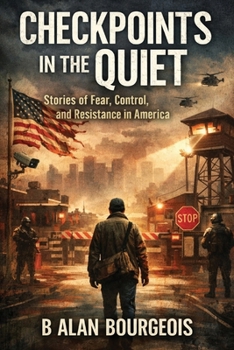
Checkpoints in the Quiet

What happens when a country stops feeling safe, truthful, or humane?
Checkpoints in the Quiet is a powerful collection of political fiction exploring life in an America shaped by fear, silence, control, and the slow unraveling of public trust. Across these gripping stories, ordinary people face censorship, institutional pressure, moral collapse, betrayal, and the personal cost of refusing to comply.
These stories are not built on spectacle. They are built on consequence. Writers, survivors, resisters, and everyday citizens struggle to hold on to dignity, identity, and purpose as the systems around them grow colder and more dangerous. Sharp, emotional, and disturbingly believable, Checkpoints in the Quiet offers a haunting portrait of a nation under strain-and the people still willing to fight for its soul.
Book Review:
Checkpoints in the Quiet is a linked collection of politically charged stories about fear, bureaucracy, surveillance, and resistance in a near-future America that feels uncomfortably close to the present. The book moves from economic precarity and the failure of performative kindness in "The Kindness That Peels Off" to the nightmare civility of "The Quiet Checkpoint," where a children's author discovers that "author status" has become a trigger for state scrutiny. From there, the collection expands into digital erasure, detention scoring, activist networks, and public resistance against systems designed to disappear people cleanly and quietly.
Bourgeois writes in a plain, accessible style that prizes urgency and clarity. The strongest sections are the ones grounded in ordinary settings-a library desk, a municipal office, a motel room, a laptop login, a community gathering-where the machinery of control feels procedural rather than theatrical. That emphasis gives the book its strongest effect: it shows how authoritarianism can arrive through systems that insist they are only trying to keep things "safe and accurate."
Readers who enjoy overtly political dystopian fiction, civic-warning narratives, and resistance stories with clear moral stakes will find a strong hook here. Readers who prefer subtle politics, more ideological ambiguity, or lighter tonal range may find the book relentless and sharply didactic in places. Even so, it is a memorable, purposeful work with a clear audience and real conviction behind it. - True Voice Review
Customer Reviews
ThriftBooks® and the ThriftBooks® logo are registered trademarks of Thrift Books Global, LLC
