


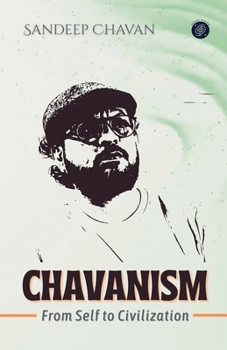
Chavanism: From Self to Civilization

What if instability is not personal failure-but structural pattern?
In Chavanism: From Self to Civilization, Independent Researcher Sandeep Chavan presents a clear and disciplined framework for understanding how imbalance forms-inside individuals, within institutions, and across civilizations.
Rather than offering ideology, dogma, or motivational prescriptions, this book examines recurring structural patterns:
Why emotional overreaction creates oscillationHow identity hardens into rigidityWhy power amplifies instability instead of correcting itHow institutions drift before they collapseWhy civilizations bend more often than they breakChavanism proposes a simple but powerful lens: disturbance is natural. Instability grows when friction is suppressed, amplified, or delayed. Stability emerges through early correction, proportional response, and continuous calibration.
The book unfolds in five parts:
Part I - The Dissolution of Illusions
Repositions the self as participant rather than origin, examining identity, awareness, and the illusion of control.
Part II - The Mechanics of Experience
Explores emotion, memory, trauma, oscillation, and recovery speed-revealing how inner instability forms and how resilience develops.
Part III - Ethics Without Cosmic Authority
Shifts from the individual to governance and responsibility, demonstrating how power amplifies existing patterns and why modulation matters more than domination.
Part IV - Civilization in Transition
Analyzes polarization, institutional drift, technological acceleration, and the conditions under which societies fracture-or adapt.
Part V - The Quiet Realization
Returns to the individual with a grounded insight: clarity does not require ideology, only disciplined observation.
This book is not self-help.
It is not political propaganda.
It is not spiritual doctrine.
It is a structural framework for readers who prefer clarity over comfort.
Ideal for thinkers, leaders, educators, policymakers, and reflective individuals navigating modern complexity, Chavanism connects psychology, governance, and civilizational dynamics within a single coherent pattern.
If you have ever wondered:
Why small tensions become major conflictsWhy institutions resist feedbackWhy polarization spreads faster than reasonWhy correction often comes too lateThis book offers a structured answer.
Chavanism does not ask for belief.
It asks for observation.
Stability is not declared.
It is maintained.
And continuity depends on how early we choose to recalibrate.
Customer Reviews
ThriftBooks ® and the ThriftBooks ® logo are registered trademarks of Thrift Books Global, LLC
