


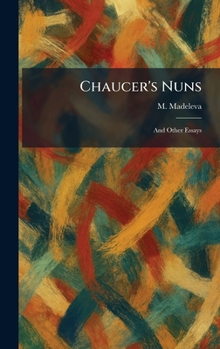
Chaucer's Nuns: And Other Essays

"Chaucer's Nuns, And Other Essays" is a profound collection of literary studies that explores the intersection of religious life and medieval poetry. Written by M. Madeleva, a celebrated scholar and poet, the title essay offers a nuanced defense and insightful analysis of the Prioress and other religious figures in Geoffrey Chaucer's "The Canterbury Tales." Through a blend of scholarly rigor and poetic insight, Madeleva provides context for the monastic life of the fourteenth century, interpreting Chaucer's work with an insider's understanding of conventual discipline and spirituality.
Beyond the titular essay, this volume includes reflections on Middle English lyrics, the mysticism of historical figures, and the nature of religious poetry. Madeleva's work is characterized by its clarity and its ability to bridge the gap between historical literature and modern readers. These essays remain a significant contribution to Chaucerian scholarship and provide valuable perspectives on the role of faith in literature. This collection is an essential read for students of medieval history, lovers of English poetry, and those interested in the enduring legacy of the Father of English Literature.
This work has been selected by scholars as being culturally important, and is part of the knowledge base of civilization as we know it. This work was reproduced from the original artifact, and remains as true to the original work as possible. Therefore, you may see the original copyright references, library stamps (as most of these works have been housed in our most important libraries around the world), and other notations in the work.
This work is in the public domain in the United States of America, and possibly other nations. Within the United States, you may freely copy and distribute this work, as no entity (individual or corporate) has a copyright on the body of the work.
As a reproduction of a historical artifact, this work may contain missing or blurred pages, poor pictures, errant marks, etc. Scholars believe, and we concur, that this work is important enough to be preserved, reproduced, and made generally available to the public. We appreciate your support of the preservation process, and thank you for being an important part of keeping this knowledge alive and relevant.
Customer Reviews
ThriftBooks ® and the ThriftBooks ® logo are registered trademarks of Thrift Books Global, LLC
