


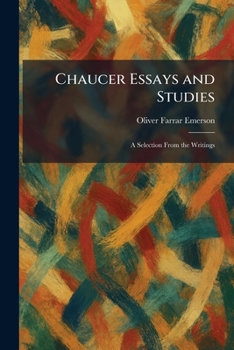
Chaucer Essays and Studies: A Selection From the Writings

Select Format
Select Condition 
Book Overview
"Chaucer Essays and Studies a Selection From the Writings" is a comprehensive collection of scholarly explorations into the life and works of Geoffrey Chaucer, one of the foundational figures of English literature. Authored by the distinguished scholar Oliver Farrar Emerson, this volume compiles a series of insightful essays that delve into the linguistic, historical, and thematic nuances of Chaucer's poetry. The work offers deep analysis of the poet's Middle English craftsmanship, providing context for "The Canterbury Tales" and other major poems within the broader landscape of 14th-century culture.
Emerson's research addresses critical questions regarding Chaucer's influences, his innovative use of the vernacular, and the intricate social structures depicted in his narratives. This selection serves as both an essential resource for students of medieval studies and an engaging guide for readers seeking a sophisticated understanding of the "Father of English Literature." By examining the technical mastery and enduring legacy of the Chaucerian corpus, this collection illuminates the vital connection between medieval literary tradition and the evolution of the English language. It remains a significant contribution to the field of literary criticism, preserving meticulous academic perspectives on a master of the written word.
This work has been selected by scholars as being culturally important, and is part of the knowledge base of civilization as we know it. This work was reproduced from the original artifact, and remains as true to the original work as possible. Therefore, you may see the original copyright references, library stamps (as most of these works have been housed in our most important libraries around the world), and other notations in the work.
This work is in the public domain in the United States of America, and possibly other nations. Within the United States, you may freely copy and distribute this work, as no entity (individual or corporate) has a copyright on the body of the work.
As a reproduction of a historical artifact, this work may contain missing or blurred pages, poor pictures, errant marks, etc. Scholars believe, and we concur, that this work is important enough to be preserved, reproduced, and made generally available to the public. We appreciate your support of the preservation process, and thank you for being an important part of keeping this knowledge alive and relevant.
Customer Reviews
ThriftBooks ® and the ThriftBooks ® logo are registered trademarks of Thrift Books Global, LLC
