


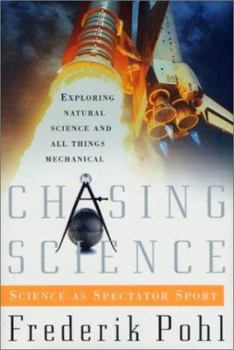
Chasing Science


Select Format
Select Condition 
Book Overview
ARCHAEOLOGY: "A good place to look for an ancient shark's tooth is along the beaches south of Annapolis, Maryland, where they wash out of the clay banks landward of the beach".VULCANOLOGY: "Most people don't think of Iceland as a suitable first choice for a vacation. But it's one of the places I personally prefer when I wish to see volcanoes in action. Either Iceland or Hawaii".ASTRONOMY: "The third Tuesday of every month is Observatory night in Cambridge, Massachusetts, when under a thirty-foot bubble of copper in the middle of the city visitors can find the fifteen-inch refractor that was once the biggest and best telescope in the United States -- the 'Great Refractor.'"HYDROLOGY: "If you happen to be in Chengdu, it's worth the trip to visit the Dujingyan Irrigation System. It's not a marvel of twentieth-century technology; it's much older than that -- 2,200 years older, to be exact".TECHNOLOGY: "To get a good look at the complexity that lies under a major city, visit Consolidated Edison's little museum on the corner of East 14th Street and Third Avenue in New York. It's a mole's eye view of what's hidden from sight under that intersection".These adventures and dozens more await you in Frederik Pohl's exploration of his lifelong love affair with science. Describing science destinations and museums around the world, Pohl reveals how anyone can join in the chase.
Format:Hardcover
Language:English
ISBN:0312867115
ISBN13:9780312867119
Release Date:December 2000
Publisher:Doherty Associates, LLC, Tom
Length:256 Pages
Weight:0.84 lbs.
Dimensions:0.9" x 5.8" x 8.6"
Customer Reviews
2 ratings
A Tour of the Sciences
Published by Thriftbooks.com User , 18 years ago
Well, now. Let us suppose, in these demon-haunted days, that you are one of those Rare and Noble Souls, a lover of science. You want to find out more about it, preferably in as interesting a manner as possible. This book is just the one for you. Its subtitle--_Science as a Spectator Sport_-- is revealing. It is crammed with places to go, things to see, and activities to do. There is an appendix of museums, observatories, learning centers, space centers, and nature preserves in different states and countries that is worth the price of the book alone. The revised edition contains two new chapters-- one on math (particularly binary counting) and one on borderline science and pseudoscience (corpsicles, saucers, and ESP). Pohl's conclusion at the end of the second chapter: "If a few thousand people read _The Skeptical Inquirer_, they are totally outnumbered by the millions who read the new best seller about reincarnation or extraterrestrial abduction" (220). I once knew a man who traveled about the country renovating old-fashioned telescopes to their former condition. I learned from him that even if the old telescopes are no longer the most powerful, they are of considerable historical value; and many are truly beautiful devices. "The Big Eyes" is a marvelous chapter on touring observatories (visual and radio, reflectors and reractors, old and new). It also contains an update on the S.E.T.I. program with suggestions on how to support it; you might even become a volunteer for it. I had never given much thought to visiting laboratories before-- they had always seemed a bit remote from the public to me. But Pohl takes us on a tour of several labs open to the public-- Fermilab, Brookhaven National Laboratory, the Argonne National Laboratory, the Sandia National Laboratory, the Mojave Power Tower, and others. In another chapter, he shows how you can listen to lectures and to shoptalk by scientists. He recounts listening to a lecture by Stephen Hawking. You can actually see a lot of science in operation, and most scientists _like_ to talk to people about what they are doing. Other chapters of interest include ones on backyard astronomy; dams, locks, and tsunamis; caves and tunnels; fossils and archeology; volcanoes and earthquakes; the space program; and publications and organizations. In an introduction to the book, Pohl acknowledges that his formal training in science is very small. But: What I am is a _fan_ of science. My relation to science is the same as my relation to the New York Mets. I don't hope to make the team, I just like to watch them play-- the difference being that, for me, science is even better as a spectator sport than baseball ever was. (11) Just so. You don't have to be a professional scientist in order to play the game. There will, of course, be many people around you who don't know how to play. But if you love the game, it won't really matter.
Easygoing writing, full of knowledge everyone should have.
Published by Thriftbooks.com User , 20 years ago
This book is at its best served as a fun read that establishes the fundamentals of a number of fascinating phemonena and studies. It is certainly not an in-depth text full of technical data, but in this case, this is a strength. It conveys some concepts and information in a paragraph or chapter in a fashion that is understandable by a reader with no background in the field. I would highly recommend it particularly to these readers; when you say, "Gosh, I didn't know that!" (as you will at least once or twice) you might just want to look closer at something you've seen all your life but never really looked at. I think it would be a great book for every high-schooler to read as an introduction to the sciences. Additionally, it serves as a great resource for curious travellers; there are many locations locally and internationally that could be an easy sidetrip on any vacation.
Copyright © 2026 Thriftbooks.com
Terms of Use | Privacy Policy | Do Not Sell/Share My Personal Information | Cookie Policy | Cookie Preferences | Accessibility Statement
ThriftBooks ® and the ThriftBooks ® logo are registered trademarks of Thrift Books Global, LLC
ThriftBooks ® and the ThriftBooks ® logo are registered trademarks of Thrift Books Global, LLC
