


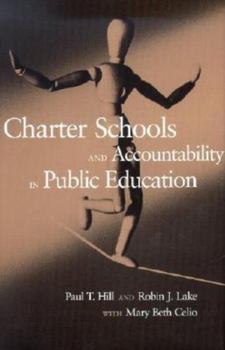
Charter Schools and Accountability in Public Education
No Customer Reviews

Select Format
Select Condition 
Book Overview
Charter schools are among the most debated and least understood phenomena in American education today. At the heart of these matters is a contested question of accountability. To survive, charter schools must make and keep promises about what students will experience and learn under their purview. However, unlike public schools, charter schools do not rely exclusively on their relationship with school districts. They must also look to parents, teachers, and donors to cooperatively establish expectations of a particular school and its mission. Aimed toward elected officials, school reform activists, and educators, this book is the result of the first national-scale study of charter school accountability. The authors researched one hundred-fifty schools and sixty authorizing agencies in Arizona, California, Colorado, Georgia, Massachusetts, and Michigan. These states contain the majority of charter schools that have been operating for three years or more and represent the major differences in state charter school legislation. The authors include interviews from a range of participants in the field(c) from state legislators and administrators to principals, teachers, and parents. In assessing the structure of accountability as it works internally to bolster external confidence, Hill and Lake suggest the struggle of charter schools actually complements those of standards based reform. Both seek to transform public education to make schools responsible for performance, not compliance.
Format:Hardcover
Language:English
ISBN:0815702663
ISBN13:9780815702665
Release Date:May 2002
Publisher:Brookings Institution Press
Length:160 Pages
Weight:0.90 lbs.
Dimensions:0.8" x 6.3" x 9.3"
Customer Reviews
0 rating
Copyright © 2026 Thriftbooks.com Terms of Use
| Privacy Policy | Do Not
Sell/Share My Personal Information | Cookie Policy | Cookie Preferences | Accessibility Statement
ThriftBooks® and the ThriftBooks® logo are registered trademarks of Thrift Books Global, LLC
ThriftBooks® and the ThriftBooks® logo are registered trademarks of Thrift Books Global, LLC
