


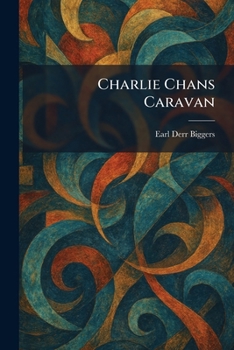
Charlie Chans Caravan

In "Charlie Chans Caravan", the legendary Inspector Charlie Chan of the Honolulu Police Department faces one of his most intricate and globe-trotting cases. The story unfolds as a diverse group of travelers on a luxury world tour becomes the center of a chilling murder investigation. When a member of the party is found dead, the quest for justice spans continents, eventually bringing the suspicious "caravan" to the shores of Hawaii.
Earl Derr Biggers delivers a masterclass in Golden Age detective fiction, blending atmosphere, suspense, and the methodical brilliance of his most famous creation. As Chan meticulously sifts through alibis and hidden motives, he proves that no detail is too small and no secret is safe from his analytical mind. "Charlie Chans Caravan" remains a cornerstone of the mystery genre, celebrated for its engaging plot and the introduction of a detective who relies on wisdom and observation rather than force.
This classic whodunit invites readers to piece together a complex puzzle alongside the unflappable Inspector Chan. With its rich setting and a cast of intriguing suspects, it is an essential read for fans of traditional police procedurals and vintage mystery literature.
This work has been selected by scholars as being culturally important, and is part of the knowledge base of civilization as we know it. This work was reproduced from the original artifact, and remains as true to the original work as possible. Therefore, you may see the original copyright references, library stamps (as most of these works have been housed in our most important libraries around the world), and other notations in the work.
This work is in the public domain in the United States of America, and possibly other nations. Within the United States, you may freely copy and distribute this work, as no entity (individual or corporate) has a copyright on the body of the work.
As a reproduction of a historical artifact, this work may contain missing or blurred pages, poor pictures, errant marks, etc. Scholars believe, and we concur, that this work is important enough to be preserved, reproduced, and made generally available to the public. We appreciate your support of the preservation process, and thank you for being an important part of keeping this knowledge alive and relevant.
Customer Reviews
ThriftBooks ® and the ThriftBooks ® logo are registered trademarks of Thrift Books Global, LLC
