


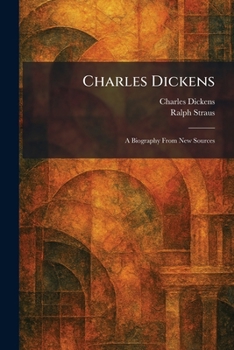
Charles Dickens: A Biography From New Sources

"CHARLES DICKENS a Biography From New Sources." provides a compelling and detailed examination of the life of one of history's most beloved novelists. Written by Ralph Straus, this work utilizes then-fresh research and private documents to offer a more nuanced look at the man who defined the Victorian literary landscape. The biography follows Dickens from his difficult childhood and his early days as a journalist to his eventual status as a global literary phenomenon.
The narrative explores the personal experiences that informed Dickens's social critiques and his vivid characterizations in classics such as "David Copperfield," "A Tale of Two Cities," and "The Pickwick Papers." Straus delves into Dickens's complex personality, his tireless work ethic, his public readings, and his deep-seated desire for social reform. This work serves as a vital bridge between the historical record and the enduring legacy of Dickens's fiction, making it an essential read for students of English literature and admirers of the Victorian age. By focusing on the human elements of the author's life, the book presents a vivid portrait of a creative genius who transformed the world of letters.
This work has been selected by scholars as being culturally important, and is part of the knowledge base of civilization as we know it. This work was reproduced from the original artifact, and remains as true to the original work as possible. Therefore, you may see the original copyright references, library stamps (as most of these works have been housed in our most important libraries around the world), and other notations in the work.
This work is in the public domain in the United States of America, and possibly other nations. Within the United States, you may freely copy and distribute this work, as no entity (individual or corporate) has a copyright on the body of the work.
As a reproduction of a historical artifact, this work may contain missing or blurred pages, poor pictures, errant marks, etc. Scholars believe, and we concur, that this work is important enough to be preserved, reproduced, and made generally available to the public. We appreciate your support of the preservation process, and thank you for being an important part of keeping this knowledge alive and relevant.
Customer Reviews
ThriftBooks ® and the ThriftBooks ® logo are registered trademarks of Thrift Books Global, LLC
