


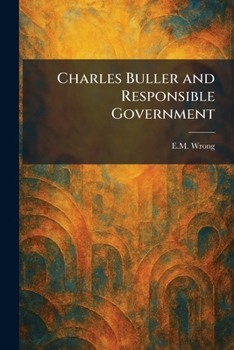
Charles Buller and Responsible Government

Select Format
Select Condition 
Book Overview
"Charles Buller and Responsible Government" is a scholarly examination of the life and political legacy of one of the 19th century's most influential colonial reformers. Written by E.M. Wrong, this work delves into the critical transition of the British Empire toward the model of responsible government, a cornerstone of modern democratic governance in the Commonwealth.
The book focuses on Charles Buller's instrumental role in drafting the landmark Durham Report and his advocacy for colonial self-determination. Through detailed historical analysis, the author explores how Buller's ideas helped resolve the tensions between the British Crown and its North American colonies, particularly Canada. By examining the constitutional debates and administrative challenges of the era, the text provides a comprehensive look at the shift from direct imperial rule to a system where colonial executives were accountable to local legislatures.
Essential for students of imperial history, political science, and Canadian studies, "Charles Buller and Responsible Government" illuminates the intellectual foundations of the modern state. It remains a vital resource for understanding the evolution of the British Empire and the origins of parliamentary democracy in former colonies. This study highlights Buller's enduring influence on the legal and political frameworks that define international relations today.
This work has been selected by scholars as being culturally important, and is part of the knowledge base of civilization as we know it. This work was reproduced from the original artifact, and remains as true to the original work as possible. Therefore, you may see the original copyright references, library stamps (as most of these works have been housed in our most important libraries around the world), and other notations in the work.
This work is in the public domain in the United States of America, and possibly other nations. Within the United States, you may freely copy and distribute this work, as no entity (individual or corporate) has a copyright on the body of the work.
As a reproduction of a historical artifact, this work may contain missing or blurred pages, poor pictures, errant marks, etc. Scholars believe, and we concur, that this work is important enough to be preserved, reproduced, and made generally available to the public. We appreciate your support of the preservation process, and thank you for being an important part of keeping this knowledge alive and relevant.
Customer Reviews
ThriftBooks ® and the ThriftBooks ® logo are registered trademarks of Thrift Books Global, LLC
