


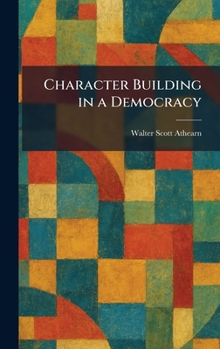
Character Building in a Democracy

"Character Building in a Democracy" explores the fundamental relationship between moral instruction and the preservation of a democratic society. Walter S. Athearn presents a compelling argument for the systematic development of character as the bedrock of national stability and progress. The work suggests that the survival of free institutions depends heavily on the spiritual and ethical grounding of its citizenry, proposing a comprehensive approach to education that addresses the whole person.
Athearn advocates for a robust framework of religious education that functions alongside public schooling to ensure that individuals are not only intellectually capable but also ethically prepared for the responsibilities of citizenship. The book examines the pedagogical methods and organizational structures required to implement effective moral training, emphasizing the need for cooperation between the home, the school, and religious institutions. By analyzing the spiritual needs of youth, Athearn highlights how a lack of moral foundation can lead to social decay.
This work remains a significant historical document in the field of educational philosophy. It offers deep insights into early 20th-century thought regarding social ethics and the belief that the future of a democracy is inextricably linked to the character of its people. "Character Building in a Democracy" is an essential resource for those interested in the history of American education and the philosophical underpinnings of civic life.
This work has been selected by scholars as being culturally important, and is part of the knowledge base of civilization as we know it. This work was reproduced from the original artifact, and remains as true to the original work as possible. Therefore, you may see the original copyright references, library stamps (as most of these works have been housed in our most important libraries around the world), and other notations in the work.
This work is in the public domain in the United States of America, and possibly other nations. Within the United States, you may freely copy and distribute this work, as no entity (individual or corporate) has a copyright on the body of the work.
As a reproduction of a historical artifact, this work may contain missing or blurred pages, poor pictures, errant marks, etc. Scholars believe, and we concur, that this work is important enough to be preserved, reproduced, and made generally available to the public. We appreciate your support of the preservation process, and thank you for being an important part of keeping this knowledge alive and relevant.
Customer Reviews
ThriftBooks ® and the ThriftBooks ® logo are registered trademarks of Thrift Books Global, LLC
