


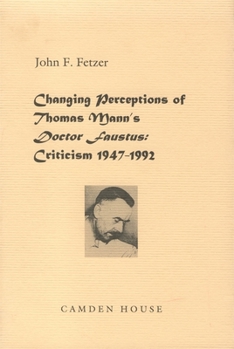
Changing Perceptions of Thomas Mann's Doctor Faustus: Criticism 1947-1992
No Customer Reviews

Ever since its appearance in 1947, Thomas Mann's novel Doctor Faustus has generated heated reactions among critics. Whereas initial ideological differences stemming from the Cold War and the division of Germany have abated following the reunification of 1990, diverse opinions and controversies persist about Mann's daring treatment of the Faust theme. These include such topics as the political stance of the author and the historical dimensions of the novel; the biographical and autobiographical backgrounds of the work - especially in the light of the subsequent publication of Mann's diaries and private notebooks; the writer's sexual and psychological proclivities; the thorny issues of montage, collage, and intertextuality; musical concerns such as the extent to which the novel's protagonist appropriates as his own Arnold Sch nberg's twelve-tone system of composition or the role of Mann's fellow exile and mentor, Theodor W. Adorno, in indoctrinating his "pupil" into avant-garde musical techniques; the degree to which the novel exhibits structural features of the music on which the narrative focuses; and the function of certain mythic prototypes for this modern parody in fashioning the fortunes and fate of Adrian Leverk hn. A provocative and still unresolved question centers on the precise role played by Goethe's Faust
Format:Hardcover
Language:English
ISBN:1571130705
ISBN13:9781571130709
Release Date:April 1996
Publisher:Camden House (NY)
Length:214 Pages
Weight:1.05 lbs.
Dimensions:0.7" x 6.7" x 9.3"
Customer Reviews
0 rating
Copyright © 2026 Thriftbooks.com Terms of Use
| Privacy Policy | Do Not
Sell/Share My Personal Information | Cookie Policy | Cookie Preferences | Accessibility Statement
ThriftBooks® and the ThriftBooks® logo are registered trademarks of Thrift Books Global, LLC
ThriftBooks® and the ThriftBooks® logo are registered trademarks of Thrift Books Global, LLC
