


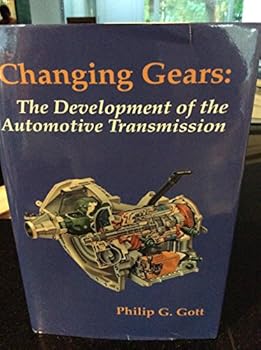
Changing Gears: The Development of the Automotive Transmission (Sae Historical Series)

A highly readable history of the passenger car transmission. From the earliest efforts to the present and beyond, Gott looks at transmission designs which have been novel, interesting, or instructive, with a special focus on those which have a direct lineage to the modern automatic transmission. Num
Format:Hardcover
Language:English
ISBN:1560910992
ISBN13:9781560910992
Release Date:January 1991
Publisher:Society of Automotive Engineers
Length:456 Pages
Weight:1.25 lbs.
Dimensions:9.5" x 1.0" x 6.3"
Related Subjects
Automotive Engineering Mechanics Science & Math Technology Textbooks TransportationCustomer Reviews
1 rating
Changing Gears Review
Published by Thriftbooks.com User , 22 years ago
I liked the stories of the people in the development teams the best, because they really brought history to life. These stories of the frustrations and successes of the technical teams trying to reach the goals of the crashless (synchomesh) manual and then the automatic hydraulic transmission gave a very human side to history.It was interesting how often a particular technology would be researched and developed, only to be shelved for a couple of decades until another team, costing, or other system constraints caught up. For example, the use by Studebaker and Packard of the lock-up torque converter exemplified how many ways or times something was tried before it became a routine industry standard. The chapter on emerging technologies (circa 1990), such as the steel belt continuously variable transmission (CVT), was surprisingly accurately predictive.I enjoyed examining the supporting pictures, drawings, and the appendix of power flow schematics for most of the automatics to 1990. I found the schematics clever in their simplicity to be understood.It would have helped to have had a reference timeline chart to refer to as an aid to help keep straight what happened when as the book is read. Also, it would be nice to see a second addition to catch up on the last decade or so. Changing Gears does not cover the use of the Lepelletier epicyclic gear train, now being applied to most 6-speed automatics. Unfortunately for me, I bought the book to find out about Pierre Lepelletier and his gear train. However, the discovery of this long history compiled in one book made up for it.This book is pretty easy reading for one on technical history, but it is sometimes difficult to envisage the mechanisms and their movements from a description in text. The bottom line: If you're interested in technical history, then I would strongly recommend this book.
Copyright © 2026 Thriftbooks.com Terms of Use
| Privacy Policy | Do Not
Sell/Share My Personal Information | Cookie Policy | Cookie Preferences | Accessibility Statement
ThriftBooks® and the ThriftBooks® logo are registered trademarks of Thrift Books Global, LLC
ThriftBooks® and the ThriftBooks® logo are registered trademarks of Thrift Books Global, LLC
