


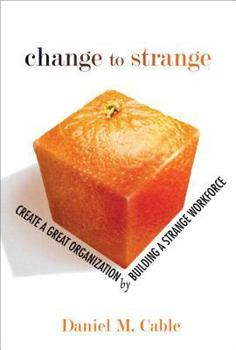
Change to Strange: Create a Great Organization by Building a Strange Workforce (Paperback)

Select Format
Select Condition 
Book Overview
To achieve sustained competitive advantage, you must create and deliver something that's valuable, rare, and hard to imitate -- and you can't do that with a run-of-the-mill workforce. Your workforce... This description may be from another edition of this product.
Format:Paperback
Language:English
ISBN:013231777X
ISBN13:9780132317771
Release Date:April 2007
Publisher:FT Press
Length:224 Pages
Weight:0.65 lbs.
Dimensions:0.5" x 6.0" x 8.9"
Customer Reviews
5 ratings
Strange Name, Odd Construct, Excellent Content
Published by Thriftbooks.com User , 18 years ago
In less than 175 pages, Dr. Daniel Cable delivers something "strange"; a 'how-to' book that nails the organizational performance connection between strategy and people! Written in a direct, talking style, by a Professor whose writing implies he is fun to learn from and with; this book argues the benefits of strategic differentiation and then explains in practical terms how to link effective strategic performance drivers to the people who must deliver that differentiating strategy. Using the term "strange" to emphasis the differentiation element of a successful strategy, the professor uses his 'strange workforce value chain' to show the steps from strategic theory to customer value creation. 1. Organizational Outcomes - three year out lagging indicators of strategic success. 2. Performance Drivers - what customers need to notice for the strategy to win. 3. Strange Workforce Deliverables - ways your people must be `strange' to make the performance drivers happen. 4. Strange Workforce Architecture - design and construct of your people management systems cause your workforce to be `strange'. An obvious fanatic on measurement as the way to speak strategy with an organization, Dr. Cable noticeably understands the difficulties, time and hard work involved (as well as the many nuances) with creating and maintaining an organization's connection with its strategy. In fact, he is so concerned about the need for an understanding of the specifics, that he holds his favorite chapter, "The Magic of Metrics", for the final chapter of the book. In the meantime he covers "Job-Specific Strangeness" where he distinguishes the strategic leverage of jobs (not leadership positions); sorting them into executor (direct deliverers of 'strange'), operator (essential players in creating value), and outsourcer (cannot be linked to `strange' performance drivers) positions. In subsequent chapters he explains his "Strange Workforce Architecture", supplementing the specifics with numerous examples of 'strangeness' in action. From uncovering the 'strange' performance drivers of a 'strange' strategy, to hiring and managing the `strange' people who fit with a 'strange' strategy's delivery, the professor conveys a compelling and instructive narrative. This book is recommended for anyone who has used or considered the balanced scorecard; it will put you on a 'strange' and better path. Dennis DeWilde, author of "The Performance Connection"
Being different and "strange" is often a requirement for success, read about it here
Published by Thriftbooks.com User , 18 years ago
In this book, Cable puts forward a very interesting idea that more managers should have the courage to take seriously and perhaps even execute. The point is that managers should make a concerted effort to hire people that are "strange" rather than those that are similar to all other potential hires. His point is that conventional thinking and execution is inherently limited in the level of success that it can achieve. By strange, he does not mean "weird" or disturbed, the term is used in the sense of being capable of doing constructive and successful thinking outside the box. Several examples of companies that have adopted such methods and are very successful are presented. One of the best is an explanation of the career of major league baseball general manager Billy Beane. Beane's position is that the standard criteria used to evaluate baseball talent are simplistic and incorrect. Since he rose to the position of general manager of the Oakland Athletics, Beane has fielded a team that ranks at the bottom in terms of salary and near the top in terms of wins. Much of his emphasis is on the "quality at-bat" where a player forces the pitcher to make extra pitches and is willing to accept a base-on-balls, even when there are runners on base. Since this is a skill undervalued by all other teams, this has allowed Beane to acquire players for much less than other teams are willing to pay them. By molding the team in that image, he has developed a very successful team, although the Athletics have had a difficult time winning games in the playoffs. Given the current financial inequities that exist in major league baseball, this is truly a major success story that others should pay attention to. Another example is the policy of Home Depot to hire contractors to work in the appropriate sections of the store. Therefore, when the do-it-yourself customer comes in, the person helping them is very knowledgeable and can provide the highest level of customer service. This service translates into an enormous competitive advantage over other stores and can increase sales several orders of magnitude over the extra salary expenses. To his additional credit, Cable also is clear in stating that hiring "strange" employees is not for everyone. It requires courage to be willing to adopt a novel business or a non-traditional approach to an old one. In nearly all cases, the initial expenses are higher than in other areas and exterior observers are generally very skeptical of the new and novel ways of doing business. I once participated in a faculty development seminar entitled, "A Whack on the Side of the Head." The purpose was to try to get us to think of new and novel ways to present our material. This book reminded me of that seminar, demonstrating that while going down a different path can be extremely challenging, it can also be very rewarding. From personal experience, those rewards are more than monetary; there is a form of satisfaction in being successfully
Yes, you really *do* want your workforce to be strange...
Published by Thriftbooks.com User , 18 years ago
The correct platitude often offered up by a company is that their people are their most important asset and competitive advantage. But in reality, most staff is like electricity... you can't run your company without them, and it's the entry level cost of doing business. In Change To Strange: Create a Great Organization by Building a Strange Workforce, Daniel M. Cable examines how to create a "strange" workforce that actually *is* a competitive advantage over your rivals. It all comes down to your definition of "strange"... Contents: Preface; Be Strange. Be Very Strange.; Shine a Flashlight into the Black Box That Exists Between Your Workforce and Beating Your Competition; Organizational Outcomes - How Do I Know I Am Winning in the Way I Want to Win?; Performance Drivers - What Must Customers Notice About Us So That We Win?; Strange Workforce Deliverables - What Our Workforce Does to Make Customers Notice and Love Us; Job Specific Strangeness - Different Deliverables from Different Jobs; Strange Workforce Architecture - What Systems Will Produce the Deliverables I Need From My Workforce?; Strange Workforce Architecture - Breaking Out From the Pack; Strange Workforce Architecture - Taking the Next Step; The Magic of Metrics - Creating and Implementing Measurement Systems;Conclusion; Index The "strange" that Cable talks about here is a workforce that obsesses about one or two key items that make a difference to the customer. For example, Whole Foods has a workforce that is obsessive about their product and presentation. These people can tell you just about anything you want to know about what they sell, because they believe in it completely. Their hiring systems are geared around making sure that new people coming into the system share that same obsessiveness, and the group is rewarded based on how well each person does. If you're not pulling your weight or if you're not obsessed like everyone else, you'll wash out. It doesn't mean you're not a hard worker or aren't cut out for working in food retail. It just means that you're not "strange" in the way you need to be to work at Whole Foods. This differentiator often is considered crazy or uncopyable by the competition. But since the customer loves it, Whole Foods has a niche all to themselves. And their people truly *are* a competitive advantage for them. The other issue that makes this difficult is the measuring and metrics. Getting information from your customers about the few things you want to be strange about is hard work. The numbers often aren't easily obtainable without putting some effort into it. Which is another reason competitors don't want to follow that direction, and why changing your workforce to a strange workforce isn't easy. But if you want your company to stand out and be different/strange, it's a requirement to be able to track those factors and measure your people against them. Otherwise you may end up with good solid people, but just not ones that are stra
If you treat your employees the same as everyone else treats theirs how can your company be unique?
Published by Thriftbooks.com User , 18 years ago
Companies often give a lot of lip service to the value of their employees but then go about treating and using everyone just about like every company treats and uses its employees. That is, with indifference and standardized "best" practices. Unsurprisingly, when an organization treats its people just about the same as every other company treats its employees (as inputs to be standardized and minimized), its dreams of having the company be something special, valuable, and unique are seldom to never realized. Daniel M. Cable tells us that only a strange workforce, that is one that doesn't do things like everyone else, one that knows and has confidence in its uniqueness and specialness and in its goals and methods, can create something that is special, unique, valuable, and with a sustainable (ongoing - but adapting) advantage in the marketplace. Cable explains how and why your workforce can become something valuable and a driving force behind your success. He starts off the book showing us how we too often treat our employees and the whole HR process as a kind of black box that just happens. We assume that if we are following the laws and standardized HR processes and avoiding being sued we are doing a good job. When we turn things around and start to view this whole concept the way the author frames it we can see that this kind of idea is indeed absurd. It is like building a process to build standardized widgets that claim no special qualities in the marketplace and then later wondering why, despite our fine leadership, those widgets fail to gain special attention in the market place or market dominance. What I like about this book is the way Cable plays with our perceptions along the way. This is not your standard business book. He asks us questions that seem odd at first, and then we realize that is the point. Have you ever looked at the back of your hand and for some reason your perception changes and it looks a different size to you and in some ways quite different than it ever had before? That is what this book will help you achieve with your workforce. The author admits that building a "strange" workforce takes a great deal of effort and probably will take some time to achieve, but if you want to be regarded as special by your customers you have to be special. And to be strange (not normal - not typical - not ordinary) you have to have strange people working for you who have a strange sense of mission. This requires you to hire strangely, train strangely, measure performance strangely, and provide strange products and services (that is, surprisingly good and surprisingly desired products and services). Cable provides a simple framework for this complex process and shows us how achieving this strangeness will get us noticed in the marketplace, allow us to satisfy our customers, and avoid the stagnation that often comes with initial success. The old tragic story of sticking with what works until it kills you has to go. On
Create a Strange Human Value Chain
Published by Thriftbooks.com User , 18 years ago
How many times have you heard a CEO count his or her work force as a "competitive advantage?" Yet a trip to that CEO's store or office reveals nothing special. Daniel M. Cable argues an organization needs to do something special to create something special. You cannot be great if your organization does what everyone else does. You have to be unique. You have to be out of the ordinary. If you want to stand above your competitors, you cannot be normal. To deliver a unique experience to your customers, your workforce must be unusual or striking. This out-of-the-ordinary experience, Cable defines as strange. Even though too man organizations claim their workforces as a competitive advantage, most do not differ from their competitors. They treat their workforce the same way their competitors do. They compare their people practices to industry averages. As a result, nothing the organization produces is particularly noteworthy from a customer's point of view. Cable, a management professor at the University of North Carolina, argues that if your organization hopes to achieve extraordinary results, your work force cannot be normal. The author offers four undeniable observations: 1. A great organization develops a sustained competitive advantage. 2. They get it by creating and delivering something to the market that is valuable, rare and hard to imitate. 3. Creating and delivering this value demands the disciplined obsession of a strange workforce. 4. A strange workforce is built by using unique metrics and strange workforce architecture. Make sure you do not quit reading before the last chapter on measurement. The book's processes rely heavily on measurement and metrics. Creating a strange workforce, the author states, relies on a process for measuring fuzzy concepts. In the last chapter, he provides it. The challenge leaders face is not developing a strategy, but translating it into reality through their workforces. Cable, whose consulting and teaching focus on bringing human systems in line with company strategy, weaves a healthy dose of practicality with inspiration to help them build a strange workforce.
Copyright © 2026 Thriftbooks.com Terms of Use
| Privacy Policy | Do Not
Sell/Share My Personal Information | Cookie Policy | Cookie Preferences | Accessibility Statement
ThriftBooks® and the ThriftBooks® logo are registered trademarks of Thrift Books Global, LLC
ThriftBooks® and the ThriftBooks® logo are registered trademarks of Thrift Books Global, LLC
