


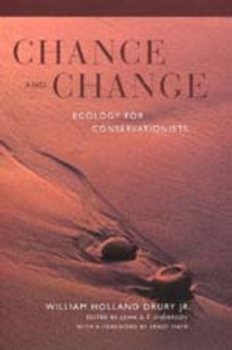
Chance and Change

The result of a lifetime in the field and in the classroom, Chance and Change challenges many of the tenets of establishment ecology. Charging that most of the environmental movement has ignored or rejected the changes in thinking that have infiltrated ecological theory since the mid 70s, William Drury presents a convincing case that disorder is what makes the natural world work, and that clinging to romantic notions of nature's grand design only saps the strength of the conservation movement. Drury's training in botany, geology, and zoology as well as his life-long devotion to work in the field gave him a depth and range of knowledge that few ecologists possess. This book opens our eyes to a new way of looking at the environment and forces us to think more deeply about nature and our role in it.
Chance and Change is intended for the serious amateur naturalist or professional conservationist. Drury argues that chance and change are the rule, that the future is as unpredictable to other organisms as it is to us, and that natural disturbance is too frequent for equilibrium models to be useful. He stresses the centrality of natural selection in explaining the meaning of biology and insists the book and the laboratory must be checked at all times against the real world. Written in an easy, personal style, Drury's narrative comes alive with the landscape-the salt marshes, dunes, seashores, and forests-that he believed served as the best classroom. His novel approach of correlating landscape evolution with ecological principles offers a welcome corrective to discordance between what we observe in nature and what theory tells us we should see.
Chance and Change is intended for the serious amateur naturalist or professional conservationist. Drury argues that chance and change are the rule, that the future is as unpredictable to other organisms as it is to us, and that natural disturbance is too frequent for equilibrium models to be useful. He stresses the centrality of natural selection in explaining the meaning of biology and insists the book and the laboratory must be checked at all times against the real world. Written in an easy, personal style, Drury's narrative comes alive with the landscape-the salt marshes, dunes, seashores, and forests-that he believed served as the best classroom. His novel approach of correlating landscape evolution with ecological principles offers a welcome corrective to discordance between what we observe in nature and what theory tells us we should see.
Format:Hardcover
Language:English
ISBN:0520211553
ISBN13:9780520211551
Release Date:June 1998
Publisher:University of California Press
Length:209 Pages
Weight:1.18 lbs.
Dimensions:0.9" x 6.3" x 9.3"
Customer Reviews
1 rating
An eye-opening critique of Clementsian ecology
Published by Thriftbooks.com User , 25 years ago
This is an amazing work whose only fault is that it was not published by a larger house. Drury clearly outlines his argument against the commonly held notion of a balance of nature. He finds the idea of ecological communities succeeding to climax a distasteful one, and rightly so. Drury advocates actually thinking about problems rather than hiding behind an orthodoxy that seems to know all the answers. He realizes that the world is a continually changing, dynamic place with an unpredictable quirkiness. It is not, as is so often assumed, a world where "ecosystems", left to their natural states, will go back to what they "ought" to be. He argues that we should conserve the world because we can, and not because of abstract notions of the intrinsic value of life. We want to save the world because we like critters, and we should fess up to it. Drury was not a scheming wise-user, as may be inferred from his criticism of the environmentalist movement. He just wanted people to think about what they had learned about ecology in the century since Clements and Forbes. Think people think!
Copyright © 2026 Thriftbooks.com
Terms of Use | Privacy Policy | Do Not Sell/Share My Personal Information | Cookie Policy | Cookie Preferences | Accessibility Statement
ThriftBooks ® and the ThriftBooks ® logo are registered trademarks of Thrift Books Global, LLC
ThriftBooks ® and the ThriftBooks ® logo are registered trademarks of Thrift Books Global, LLC
