


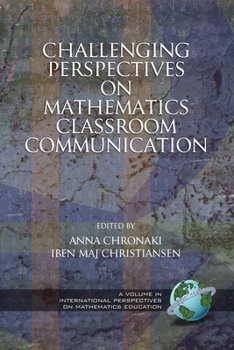
Challenging Perspectives on Mathematics Classroom Communication (PB)
No Customer Reviews

The editors and contributors of these ten articles focus on the idea that communication includes both what is happening and being said among participants in a classroom and also the politics, values and ideologies that serve as the foundation of the practice. They describe how communication thereby involves register, representation and contexts through media-human interfaces in the classroom and in interpreting mathematics as a text, how communication in mathematics teaching becomes social interaction in cooperative settings and classroom activities, and how communication translates into practice, community, identity and policy.
Format:Paperback
Language:English
ISBN:1593111517
ISBN13:9781593111519
Release Date:November 2004
Publisher:Information Age Publishing
Length:384 Pages
Weight:1.18 lbs.
Dimensions:0.8" x 6.1" x 9.2"
Customer Reviews
0 rating
Copyright © 2025 Thriftbooks.com
Terms of Use | Privacy Policy | Do Not Sell/Share My Personal Information | Cookie Policy | Cookie Preferences | Accessibility Statement
ThriftBooks ® and the ThriftBooks ® logo are registered trademarks of Thrift Books Global, LLC
ThriftBooks ® and the ThriftBooks ® logo are registered trademarks of Thrift Books Global, LLC
