


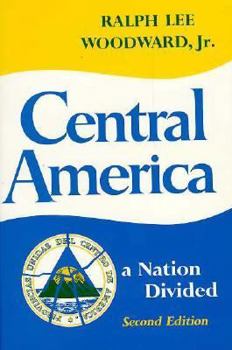
Central America: A Nation Divided (Latin American Histories)

Select Format
Select Condition 
Book Overview
This popular text surveys the history of the Central American region, covering Guatemala, Belize, Honduras, El Salvador, Nicaragua, Costa Rica, and Panama, from pre-Columbian times to the present. It emphasizes the common characteristics of the Central American states as well as their potential for political union. Now completely updated, the third edition of Central America: A Nation Divided encompasses the significant new research and tumultuous events that have taken place since the last edition was published. The text now includes coverage of the civil wars in Guatemala, El Salvador, and Nicaragua, as well as the restoration of peace to the region under the Central American peace accords. It also recounts and analyzes the substantial changes that have occurred in the economic and social arenas as Central American states have turned increasingly to neoliberal policies that emphasize the private sector and the development of exports while reducing government entitlement programs. Students will find this text enormously helpful for sorting through the vast amounts of significant research that has been written and compiled in the past decade. In addition, the Selective Guide to the Literature section has been completely revised to reflect the great increase in research and writing on Central America. Comprehensive and incisively written, Central America: A Nation Divided is an essential text for Latin American History courses.
Format:Paperback
Language:English
ISBN:0195035933
ISBN13:9780195035933
Release Date:April 1985
Publisher:Oxford University Press
Length:400 Pages
Weight:0.91 lbs.
Dimensions:8.0" x 0.8" x 5.3"
Related Subjects
Americas Asia Central America Europe History Humanities India International Relations Language Arts Latin AmericaCustomer Reviews
3 ratings
An interesting thesis and a wonderful overview
Published by Thriftbooks.com User , 19 years ago
Woodward does an excellent job of showing how Central America developed from the Kingdom of Guatemala into the nations it is today. His view of Central America includes Guatemala, Costa Rica, Honduras, El Salvador and Belize. Panama is considered a part of South America and left out of most discussions for that reason. South America went through a tumultuous time during its years under Spanish rule and despite the bourbon reforms it did not advance as Mexico or South America did. The terrain is unforgiving with malaria filled swamps along the coast and steep mountains at the top. This did not allow for the development of railroads in the post independence period or for much economic development beyond coffee production. This coffee production was difficult to ship as they lacked the infrastructure to send the product across the world. The dictatorships that would come about after the wars for independence found another source of revenue. The so called Banana republics would suffer many intrusions from filibusters but became stronger in the process. The dictatorships of the Somoza's and others would outlast many different groups causing all sorts of problems across Central America. This book seeks to capture this turbulent time period and put forth a question that has no easy answer. Why did Central America fragment into so many disparate pieces instead of remaining whole? This country would remain a nation divided of people who had common background under Spain but did not have unity in independence. One of the reasons for this is the tremendous competition between right and left. These two forces would hold sway over various aspects of these countries development through the end of the cold war. This is a great read for those who want to gain a sense of what Central America looks like and why it developed the way it did.
Excellent background
Published by Thriftbooks.com User , 22 years ago
Mr. Lockard's review is correct: for particular periods, there are better books. However, for an overall, remarkably balanced review of the History of Central America from the time of the first European contact to the near present, I don't think you will find a better book. I found the 280 pages an easy read, but maybe that's because, in giving us a basic chronological account of political events, the author shows us how one leads to the next, and supplies the local economic, social context in which these events take place, and the international forces acting upon them. Anyone who has read this book is much better prepared to understand what is now happening in that country, and to judge what works and what doesn't work in the way of US foreign policy towards that part of the world. And besides, just the extensive bibliography is worth the price of the book.
A review of Central America: A Nation Divided
Published by Thriftbooks.com User , 26 years ago
Ralph Woodward's Central America: A Nation Divided, has been the best introductory book to the region. This third edition is a clear improvement over the previous editions. Both the chronology and the bibliography have been updated and expanded. (The Bibliography is now 77 pages long!) The book is strong on the era of independence and the early national period (1780's to 1840's). It is excellent for the 1970's to the present. All of the countries are evenly covered, including Belize. However, it is not as comprehensive for the rest of the 19th century when coffee and bananas permanently shaped the economies and societies of the region. It is also weak on the Indian cultures prior to the Spanish conquest.
Copyright © 2026 Thriftbooks.com
Terms of Use | Privacy Policy | Do Not Sell/Share My Personal Information | Cookie Notice | Cookie Preferences | Accessibility Statement
ThriftBooks ® and the ThriftBooks ® logo are registered trademarks of Thrift Books Global, LLC
ThriftBooks ® and the ThriftBooks ® logo are registered trademarks of Thrift Books Global, LLC
