


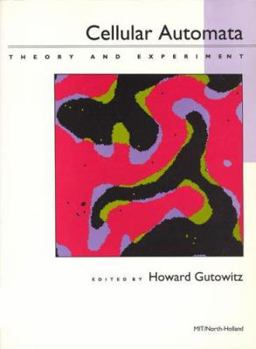
Cellular Automata: Theory and Experiment (Special Issues of Physica D)

The thirty four contributions in this book cover many aspects of contemporary studies on cellular automata and include reviews, research reports, and guides to recent literature and available software. Cellular automata, dynamic systems in which space and time are discrete, are yielding interesting applications in both the physical and natural sciences. The thirty four contributions in this book cover many aspects of contemporary studies on cellular automata and include reviews, research reports, and guides to recent literature and available software. Chapters cover mathematical analysis, the structure of the space of cellular automata, learning rules with specified properties: cellular automata in biology, physics, chemistry, and computation theory; and generalizations of cellular automata in neural nets, Boolean nets, and coupled map lattices.Current work on cellular automata may be viewed as revolving around two central and closely related problems: the forward problem and the inverse problem. The forward problem concerns the description of properties of given cellular automata. Properties considered include reversibility, invariants, criticality, fractal dimension, and computational power. The role of cellular automata in computation theory is seen as a particularly exciting venue for exploring parallel computers as theoretical and practical tools in mathematical physics. The inverse problem, an area of study gaining prominence particularly in the natural sciences, involves designing rules that possess specified properties or perform specified task. A long-term goal is to develop a set of techniques that can find a rule or set of rules that can reproduce quantitative observations of a physical system. Studies of the inverse problem take up the organization and structure of the set of automata, in particular the parameterization of the space of cellular automata. Optimization and learning techniques, like the genetic algorithm and adaptive stochastic cellular automata are applied to find cellular automaton rules that model such physical phenomena as crystal growth or perform such adaptive-learning tasks as balancing an inverted pole.Howard Gutowitz is Collaborateur in the Service de Physique du Solide et R sonance Magnetique, Commissariat a I'Energie Atomique, Saclay, France.
Format:Paperback
Language:English
ISBN:0262570866
ISBN13:9780262570862
Release Date:August 1991
Publisher:Bradford Books
Length:499 Pages
Weight:2.60 lbs.
Dimensions:10.5" x 0.8" x 7.8"
Customer Reviews
1 rating
comment by the editor of the book
Published by Thriftbooks.com User , 24 years ago
This book is 10 years old, but in this slow-moving field where results are hard won,most of it is still worthwhile. Just thefact that you are contemplating buying thisbook puts you in a very rare class IV of individuals. Confirm your status and buya copy! 2000 were printed, looks like a fewstill left. get 'em while they're hot.
Copyright © 2026 Thriftbooks.com Terms of Use
| Privacy Policy | Do Not
Sell/Share My Personal Information | Cookie Policy | Cookie Preferences | Accessibility Statement
ThriftBooks® and the ThriftBooks® logo are registered trademarks of Thrift Books Global, LLC
ThriftBooks® and the ThriftBooks® logo are registered trademarks of Thrift Books Global, LLC
