


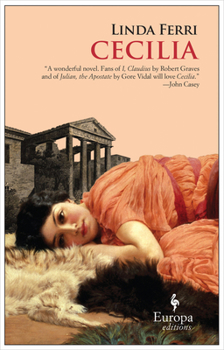
Cecilia

Select Format
Select Condition 
Book Overview
Cecilia tells the story of a young woman's search to find her place in a world that is rife with social upheaval and religious conflict. Born ito a noble Roman family in the second century, under the rule of the last of the "five good emperors," Marcus Aurelius, Cecilia seeks knowledge with the urgency and awkwardness typical of her tender age. But in a society where a woman's freedom to explore her beliefs, talents and ambitions is severely limited, Cecilia's quest amounts to a constant and painful confrontation with the world around her. Searching for light in a time of darkness and for answers among warring ideologies and beliefs, including the nascent Christian faith that she ultimately embraces, though not without her doubts, Cecilia is both a product of her times and a young woman at odds with her surroundings. In Linda Ferri's elegant prose, Cecilia tells the story of a soul's progress. It recounts an enthralling journey from a restless and searching child to a woman endowed with the strength to risk her own death in defense of her beliefs.
Format:Paperback
Language:English
ISBN:1933372877
ISBN13:9781933372877
Release Date:April 2010
Publisher:Europa Editions
Length:288 Pages
Weight:0.82 lbs.
Dimensions:1.1" x 5.3" x 8.2"
Age Range:18 years and up
Grade Range:Grade 12 and higher
Customer Reviews
2 ratings
Wonderful piece of Historical Fiction
Published by Thriftbooks.com User , 15 years ago
St. Cecilia has always been a favorite saint of mine, so when I saw this at the local bookstore, I was thrilled and bought it in a heartbeat. I was not let down. Ms. Ferri creates a very human and relateable character. Cecilia is moving and touching and I felt that I was right there with the character. An excellent book. Should be made into a movie.
"...no word, no sound or color in this world would enable me to describe the light that suddenly env
Published by Thriftbooks.com User , 15 years ago
The above quotation continues, "I saw it, I perceived its fragrance and heard its harmony though I was dissolved in its sweet crown of fire: a light compared to which the sun would appear opaque and pale, a light that permeated soul and body, dissolving boundaries, and emanated happiness and love, peace and fulfillment." A young woman in Imperial Rome is trying to describe her elation at her mystic union with the ineffable. Something traumatic and life-threatening had brought her to this ecstasy, but she would use it to turn away from the pantheon of gods she had known to the one God and Christ. Since the Rome at the end of Marcus Aurelius' rule (180 A.D.) considered Christianity atheistic, by adopting it and being baptized, despite being of a high-born family, Cecilia joined the ranks of those who could at any time be discovered, captured, and tortured to death. Saint Cecilia, according to Catholic Church history, was martyred for her faith, after both her husband, Valerian, and his brother met the same fate. However, hagiography claims miracles during several attempted executions of Cecilia, although she finally succumbed after three days. Because the story of this saint is by turns sketchy or possiblly legend, Linda Ferri has plenty of elbow room to embellish in the name of rounding out characters, time, and place; and she makes good her advantage, for the most part. Cecilia is a work of literary art that beautifully, poetically, expresses the insecurities, jealousies, astute observations, passions and changes that overcome this Roman girl both before and after her marriage. An only child because other siblings had been miscarried or died by the age of five, teenage Cecilia begs for a delay in arranged nuptials. She, like her father, loves learning, and she fears having to endure losses similar to her mother's. She is inquisitive, sensitive, and already feels a guilt about a slave's death that occurred when they were children playing together. But, when Valerian comes along, Cecilia's passionate nature leads her to join with him eagerly. Then Ferri diverges substantially from the usual history by having only Cecilia convert. The author's Valerian is an ambitious young man who wants nothing to do with this zealous sect, so Cecilia is left to her own devices in the secret Christian community that teems with its own insecurities and pettiness as it struggles to spread the gospel. I was rather disappointed that Ferri chose to depict Cecilia and Valerian as ultimate opponents rather than allies, but possibly the choice was made to strengthen Cecilia as a character of courage and destiny. On the other hand, Ferri's decision not to describe the traditional agonies of Cecilia's last days was a good one, in my relieved opinion. Her Cecilia escapes execution and can pray, "Lord, we must trust you with humility, accept your miracles: the dream you gave my father about my lifeless body, life that I wanted and that you wished to give me again." H
Copyright © 2026 Thriftbooks.com Terms of Use
| Privacy Policy | Do Not
Sell/Share My Personal Information | Cookie Policy | Cookie Preferences | Accessibility Statement
ThriftBooks® and the ThriftBooks® logo are registered trademarks of Thrift Books Global, LLC
ThriftBooks® and the ThriftBooks® logo are registered trademarks of Thrift Books Global, LLC
