


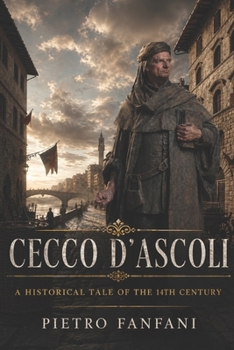
CECCO D'ASCOLI (Translated): A Historical Tale of the 14th Century

The work "Cecco d'Ascoli" by Pietro Fanfani, set in the 14th century, is significant in various historical and literary aspects. Although this novel is a product of the 19th century, it seeks to revive and recreate a crucial era in Italian history through the narration of the adventures and events related to Francesco Stabili, known as Cecco d'Ascoli, a real historical figure who lived between the late 13th and early 14th centuries.
From a historical perspective, the work offers a glimpse into the political, social, and cultural life of medieval Italy, with a particular focus on the city of Florence. The narrative highlights the political tensions and power struggles between the Guelph and Ghibelline factions, central elements of Italian communal life during that period. The historical context is enriched by accurate details regarding the architecture, customs, and attire of the era, providing the reader with an immersion in the atmosphere of the 14th century.
From a literary standpoint, Fanfani's work is part of the 19th-century tradition of historical novels, which aimed to educate and entertain the public through the evocation of bygone eras. "Cecco d'Ascoli" distinguishes itself for its attempt to combine historical accuracy with romanticized narrative elements, integrating historical figures with fictional characters to enrich the plot and make it more compelling.
Furthermore, the work reflects the cultural and intellectual debate of the 19th century regarding the evaluation of magic, science, and knowledge in general, themes embodied in the figure of Cecco d'Ascoli, presented as a scientist, astrologer, and, according to the accusations, a magician. His figure symbolizes the conflict between rational knowledge and superstitious beliefs, highlighting the complex relationship between science, philosophy, and ecclesiastical power in the Middle Ages.
"Cecco d'Ascoli" by Pietro Fanfani, therefore, contributes not only to preserving the memory of a controversial historical figure but also to reflecting on the cultural and intellectual tensions of its time, offering insights into the nature of knowledge, power, and the struggle for freedom of thought.
Customer Reviews
ThriftBooks ® and the ThriftBooks ® logo are registered trademarks of Thrift Books Global, LLC
