


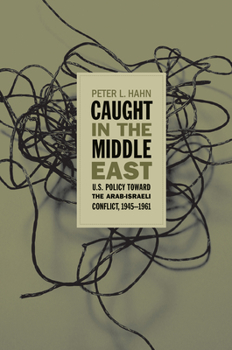
Caught in the Middle East: U.S. Policy Toward the Arab-Israeli Conflict, 1945-1961


Select Format
Select Condition 
Book Overview
American postwar efforts to ameliorate Arab-Israeli relations entangled the United States in the Arab-Israeli conflict in complex ways. Peter L. Hahn explores the diplomatic and cultural factors that influenced the policies of Presidents Truman and Eisenhower as they faced the escalation of one of the modern world's most intractable disputes.
Truman tended to make decisions in an ad hoc, reactive fashion. Eisenhower, in contrast, had a more proactive approach to the regional conflict, but strategic and domestic political factors prevented him from dramatically revising the basic tenets Truman had established.
American officials desired -- in principle -- to promote Arab-Israeli peace in order to stabilize the region. Yet Hahn shows how that desire for peace was not always an American priority, as U.S. leaders consistently gave more weight to their determination to contain the Soviet Union than to their desire to make peace between Israel and its neighbors.
During these critical years the United States began to supplant Britain as the dominant Western power in the Middle East, and U.S. leaders found themselves in two notable predicaments. They were unable to relinquish the responsibilities they had accepted with their new power -- even as those responsibilities became increasingly difficult to fulfill. And they were caught in the middle of the Arab-Israeli conflict, unable to resolve a dispute that would continue to generate instability for years to come.
Truman tended to make decisions in an ad hoc, reactive fashion. Eisenhower, in contrast, had a more proactive approach to the regional conflict, but strategic and domestic political factors prevented him from dramatically revising the basic tenets Truman had established.
American officials desired -- in principle -- to promote Arab-Israeli peace in order to stabilize the region. Yet Hahn shows how that desire for peace was not always an American priority, as U.S. leaders consistently gave more weight to their determination to contain the Soviet Union than to their desire to make peace between Israel and its neighbors.
During these critical years the United States began to supplant Britain as the dominant Western power in the Middle East, and U.S. leaders found themselves in two notable predicaments. They were unable to relinquish the responsibilities they had accepted with their new power -- even as those responsibilities became increasingly difficult to fulfill. And they were caught in the middle of the Arab-Israeli conflict, unable to resolve a dispute that would continue to generate instability for years to come.
Format:Paperback
Language:English
ISBN:0807857009
ISBN13:9780807857007
Release Date:February 2006
Publisher:University of North Carolina Press
Length:416 Pages
Weight:1.36 lbs.
Dimensions:1.0" x 6.5" x 9.2"
Customer Reviews
1 rating
Broader scope than the subtitle suggests
Published by Thriftbooks.com User , 17 years ago
Although the title suggests that only U.S. policy towards the Arab-Israeli conflict is covered in the book, Peter Hahn provides a concise, yet thorough look at the broader Middle Eastern policies of Presidents Truman and Eisenhower. Far from covering only the Arab-Israeli issue, Hahn looks at the Anglo-American relationship with the other major Arab countries in the region such as Egypt, Iraq, and Saudi Arabia. At the beginning of the book, Hahn acknowledges the inherent difficulty of writing about such a touchy political topic. His stated goal is to "empathize with all sides of the Arab-Israeli dispute, but sympathize with no one." Hahn succeeds in this goal because at no point throughout the book can someone credibly claim bias or favoritism to one side or the other. The main point of the book, if one were to narrow it down to a single statement, is to explore the ways in the U.S. (along with Britain) handled the Arab-Israeli dispute, while paying particular attention to Cold War concerns. Hahn argues that the U.S. had a significant interest in resolving the dispute, but that both sides in many cases refused to budge. Add that to the claim that the U.S. placed greater priority on larger Cold War politics than forcing a settlement on the Arab-Israeli issue, and the result is a conflict that dragged on with no real results. Hahn looks at the various pressures facing Truman and Eisenhower during this period and presents a scenario where domestic constituencies favored pro-Israel policies, while many in the State and Defense Departments feared alienating Arab countries lest the Soviets gain a foothold in the region. Hahn depicts Truman as being much more vulnerable to domestic political pressures than Eisenhower, and also that Truman was much more reactive and inconsistent in his policy choices than his successor. Hahn's book is relatively straightforward and easy to follow. This being the third book from the University of North Carolina Press I've read recently that covers this time period, I would say that Hahn's book is noticeably better than Little's book American Orientalism, but not as good as Yaqub's book Containing Arab Nationalism. Reading all three books together though provides a very in-depth look at Western policy towards the Middle East at the outset of the Cold War. The organization of Hahn's book is the best though. If one were pressed for time, keep in mind that the conclusions of each chapter do a nice job of summarizing the material. Although there is never a substitute for reading a book cover to cover, reading the first and last chapters, plus the intros and conclusions to those in between would give the reader a fairly good overview of the subject.
Copyright © 2026 Thriftbooks.com Terms of Use
| Privacy Policy | Do Not
Sell/Share My Personal Information | Cookie Policy | Cookie Preferences | Accessibility Statement
ThriftBooks® and the ThriftBooks® logo are registered trademarks of Thrift Books Global, LLC
ThriftBooks® and the ThriftBooks® logo are registered trademarks of Thrift Books Global, LLC
