


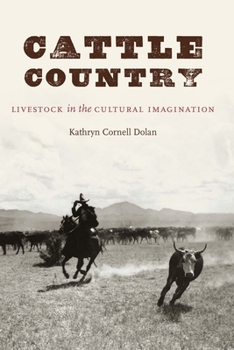
Cattle Country: Livestock in the Cultural Imagination
No Customer Reviews

Select Format
Select Condition 
Book Overview
As beef and cattle production progressed in nineteenth-century America, the cow emerged as the nation's representative food animal and earned a culturally prominent role in the literature of the day. In Cattle Country Kathryn Cornell Dolan examines the role cattle played in narratives throughout the century to show how the struggles within U.S. food culture mapped onto society's broader struggles with colonization, environmentalism, U.S. identity, ethnicity, and industrialization. Dolan examines diverse texts from Native American, African American, Mexican American, and white authors that showcase the zeitgeist of anxiety surrounding U.S. identity as cattle gradually became an industrialized food source, altering the country's culture while exacting a high cost to humans, animals, and the land. From Henry David Thoreau's descriptions of indigenous cuisines as a challenge to the rising monoculture, to Washington Irving's travel narratives that foreshadow cattle replacing American bison in the West, to Mar a Amparo Ruiz de Burton's use of cattle to connect race and imperialism in her work, authors' preoccupations with cattle underscored their concern for resource depletion, habitat destruction, and the wasteful overproduction of a single breed of livestock. Cattle Country offers a window into the ways authors worked to negotiate the consequences of the development of this food culture and, by excavating the history of U.S. settler colonialism through the figure of cattle, sheds new ecocritical light on nineteenth-century literature.
Format:Hardcover
Language:English
ISBN:1496218647
ISBN13:9781496218643
Release Date:June 2021
Publisher:University of Nebraska Press
Length:342 Pages
Weight:1.49 lbs.
Dimensions:0.9" x 6.0" x 9.0"
Customer Reviews
0 rating
Copyright © 2026 Thriftbooks.com Terms of Use
| Privacy Policy | Do Not
Sell/Share My Personal Information | Cookie Policy | Cookie Preferences | Accessibility Statement
ThriftBooks® and the ThriftBooks® logo are registered trademarks of Thrift Books Global, LLC
ThriftBooks® and the ThriftBooks® logo are registered trademarks of Thrift Books Global, LLC
