


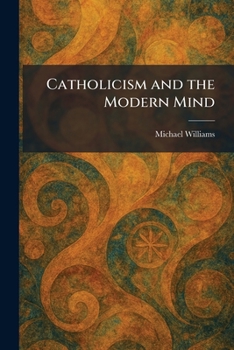
Catholicism and the Modern Mind

Select Format
Select Condition 
Book Overview
"Catholicism and the Modern Mind" is a compelling exploration of the intersection between traditional faith and the shifting intellectual landscape of the early twentieth century. This work examines the relevance and vitality of the Catholic Church in an era increasingly defined by secularism, scientific advancement, and philosophical skepticism.
Through a series of insightful essays, Michael Williams addresses the challenges posed by modern thought while articulating a robust defense of the Catholic worldview. He argues that rather than being an outdated institution, the Church offers a necessary moral and spiritual foundation for a world in transition. The text delves into themes of social justice, the role of the laity, and the perennial search for truth in a fragmented society.
This volume serves as a significant historical document of Catholic apologetics, reflecting the tensions and aspirations of a faith community seeking to engage meaningfully with the contemporary world. "Catholicism and the Modern Mind" remains a vital resource for those interested in the history of Christian thought, the evolution of religious identity, and the ongoing dialogue between faith and reason.
This work has been selected by scholars as being culturally important, and is part of the knowledge base of civilization as we know it. This work was reproduced from the original artifact, and remains as true to the original work as possible. Therefore, you may see the original copyright references, library stamps (as most of these works have been housed in our most important libraries around the world), and other notations in the work.
This work is in the public domain in the United States of America, and possibly other nations. Within the United States, you may freely copy and distribute this work, as no entity (individual or corporate) has a copyright on the body of the work.
As a reproduction of a historical artifact, this work may contain missing or blurred pages, poor pictures, errant marks, etc. Scholars believe, and we concur, that this work is important enough to be preserved, reproduced, and made generally available to the public. We appreciate your support of the preservation process, and thank you for being an important part of keeping this knowledge alive and relevant.
Customer Reviews
ThriftBooks ® and the ThriftBooks ® logo are registered trademarks of Thrift Books Global, LLC
